Common Vinyl Valuation Mistakes
Finding an old record in your collection can raise an exciting question: how much is it worth? A quick online search might reveal listings priced at $20, $200, or even $2,000 for what appears to be the same album. Unfortunately, those numbers do not necessarily represent what your particular copy could sell for.
Accurate vinyl record valuation requires more than finding a matching album cover. Pressing identification, record condition, actual sales history, and collector demand all play important roles. Understanding common valuation mistakes can help you avoid unrealistic expectations and make better decisions when buying, selling, or researching records.
Why Vinyl Record Values Can Be Misleading
Vinyl records are not standardized commodities. Even copies of the same album may differ in manufacturing history, mastering, condition, packaging, and collector desirability.
Online marketplaces also contain a mixture of completed transactions, active listings, unusually high asking prices, and incorrectly identified editions. Without examining the underlying information, it is easy to draw the wrong conclusion.
The Most Common Vinyl Valuation Mistakes
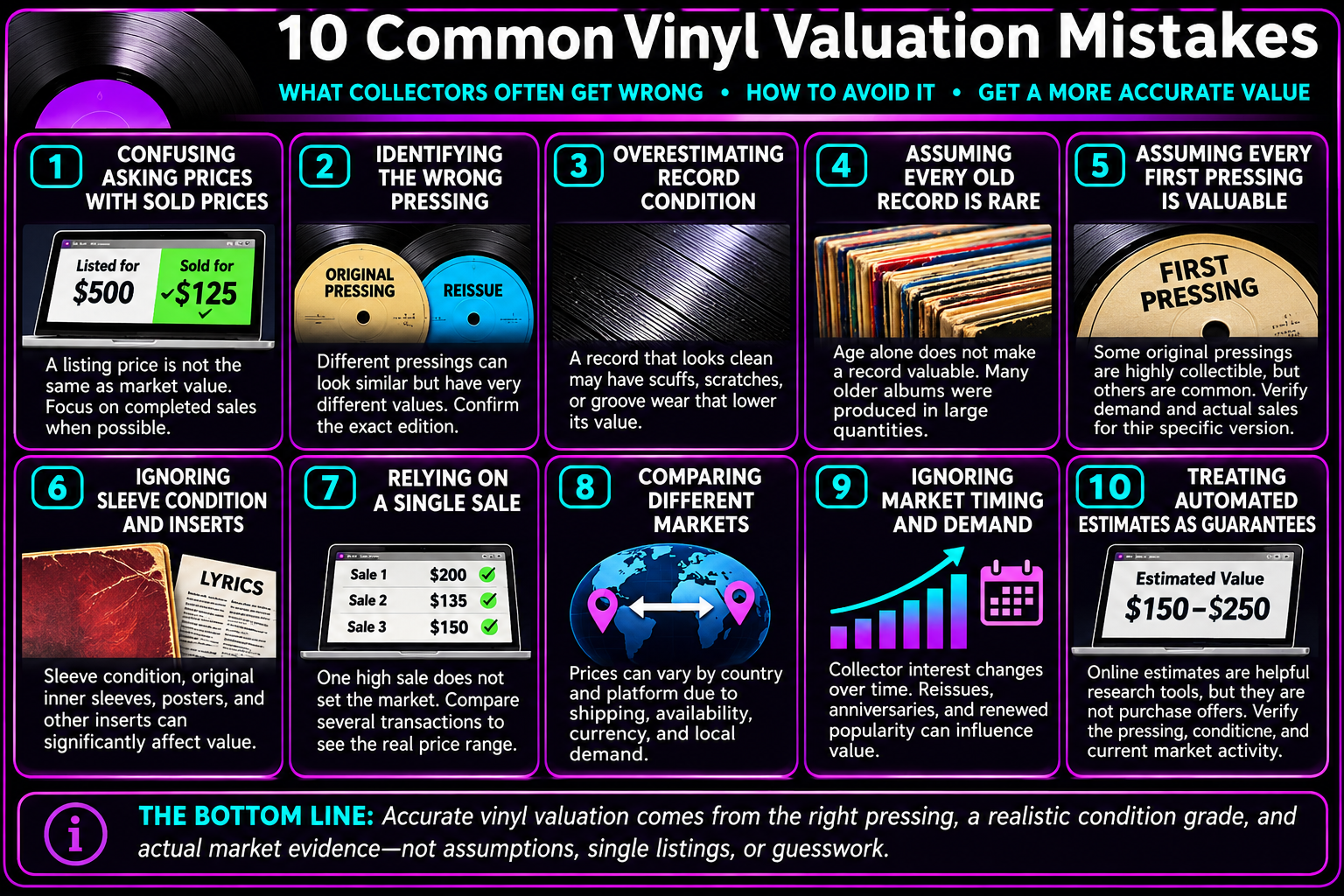
1. Confusing Asking Prices With Actual Selling Prices
One of the most common mistakes is assuming that a record listed for $500 is worth $500. Sellers can ask almost any price, but an asking price does not establish market value.
Completed sales are generally more informative because they reflect transactions that actually occurred. Even then, unusual sales should be examined carefully before drawing conclusions.
2. Identifying the Wrong Pressing
Different pressings of the same album can have very different collector values. A common later reissue may resemble a scarce original pressing, particularly when the cover artwork and catalog number are similar.
Compare label designs, matrix numbers, runout inscriptions, country of manufacture, and packaging details before relying on a price comparison.
Our vinyl pressing identification guide explains the process in greater detail.
3. Overestimating Record Condition
A record that looks clean at first glance may have sleeve scuffs, scratches, groove wear, or playback problems. Small condition differences can substantially affect collector value.
A Near Mint copy may command a premium compared with a Very Good copy of the same pressing. However, the size of that premium varies by release.
Learn how to assess condition in our vinyl record grading guide.
4. Assuming Every Old Record Is Rare
Age alone does not make a record valuable. Many albums from the 1950s, 1960s, and 1970s were produced in very large quantities and remain readily available.
Scarcity, demand, pressing variations, historical significance, and condition are often more important than age by itself.
5. Assuming Every First Pressing Is Valuable
Some original pressings are highly collectible, but others are common. A first pressing from a large manufacturing run may be worth less than a limited later edition.
Before assigning a premium, confirm the pressing and compare actual market activity for that specific version.
See our first pressing vs. reissue guide for additional information.
6. Ignoring Sleeve Condition and Missing Inserts
The outer sleeve, original inner sleeve, posters, lyric sheets, and other inserts can influence collector value. A record with an excellent disc but a badly damaged cover may sell for less than a complete, well-preserved copy.
Compare media and sleeve grades separately, and note any missing components.
7. Relying on a Single Sale
One unusually high transaction does not necessarily represent the normal market. A sale may involve exceptional condition, a rare variation, unusual bidding activity, or circumstances not obvious from the headline price.
Whenever possible, review several relevant transactions and consider the range of prices rather than relying on one example.
8. Comparing Different Markets Without Context
Record prices can differ across countries and selling platforms. Shipping costs, local availability, currency differences, and collector demand can influence transactions.
A sale in one country may not directly predict what the same record will sell for elsewhere.
9. Ignoring Market Timing and Demand
Collector interest changes over time. Reissues, artist publicity, anniversaries, and shifts in musical trends can influence demand for particular records.
Historical sales provide useful context, but they do not guarantee that a record will achieve the same price today.
10. Treating Automated Estimates as Guaranteed Prices
Online research tools can make it easier to compare prices, but an estimate is not an offer to purchase. Actual selling prices depend on the specific copy, buyer interest, selling conditions, and market timing.
Use automated comparisons as research aids, then verify pressing details and condition before making important decisions.
How to Research Vinyl Record Values More Accurately
A reliable valuation process combines several kinds of evidence rather than depending on a single number.
- Identify the exact pressing. Record the catalog number, label details, country, and complete matrix inscriptions.
- Assess the condition. Evaluate the disc and sleeve separately using recognized grading terminology.
- Find comparable sales. Look for completed transactions involving the same pressing and similar condition.
- Compare several results. Consider the typical range and investigate unusually high or low prices.
- Account for completeness. Check whether inserts, posters, or original packaging are included.
- Consider current demand. Review whether comparable copies are selling regularly or only occasionally.
Discogs Prices vs. eBay Listings
Discogs and eBay can provide complementary information when researching vinyl values.
Discogs is useful for locating specific release variations and examining condition-based marketplace information. eBay provides another perspective through listings and, where available, completed or sold transaction data.
However, these sources should not be treated as interchangeable. Active eBay listings represent seller asking prices, while completed sales provide stronger evidence of actual transactions. Discogs statistics may reflect historical sales and should be interpreted in context.
Why Pressing Identification Comes Before Valuation
Imagine two copies of an album with identical cover artwork. One is a common later reissue, while the other is a documented scarce manufacturing variation. Searching by artist and album title alone may combine prices for both versions.
By examining the center label, runout markings, and other manufacturing details, you can narrow down the exact release and compare it against more relevant market information.
Our pressing plant identification guide explains how manufacturing marks can provide additional clues.
When a Professional Appraisal May Be Appropriate
For unusually rare records, large collections, insurance documentation, or estate purposes, a qualified specialist may provide a more detailed assessment.
Online price research remains valuable, but formal appraisals may require additional documentation, inspection, and a clearly defined valuation purpose.
The Bottom Line: Research Before You Price
Determining what a vinyl record is worth is a process of matching the correct edition, assessing condition, and examining relevant market evidence. The more accurately you identify your copy, the more meaningful your price comparisons become.
For additional information about scarcity and collector demand, visit our guide to rare and unusual vinyl records.
Research Your Record’s Potential Value
KlassicVinyl helps collectors research vinyl records by displaying condition-based Discogs pricing and comparable eBay listings in one place. Use the information to investigate the market without manually searching multiple sources.