Mono vs. Stereo Vinyl Records
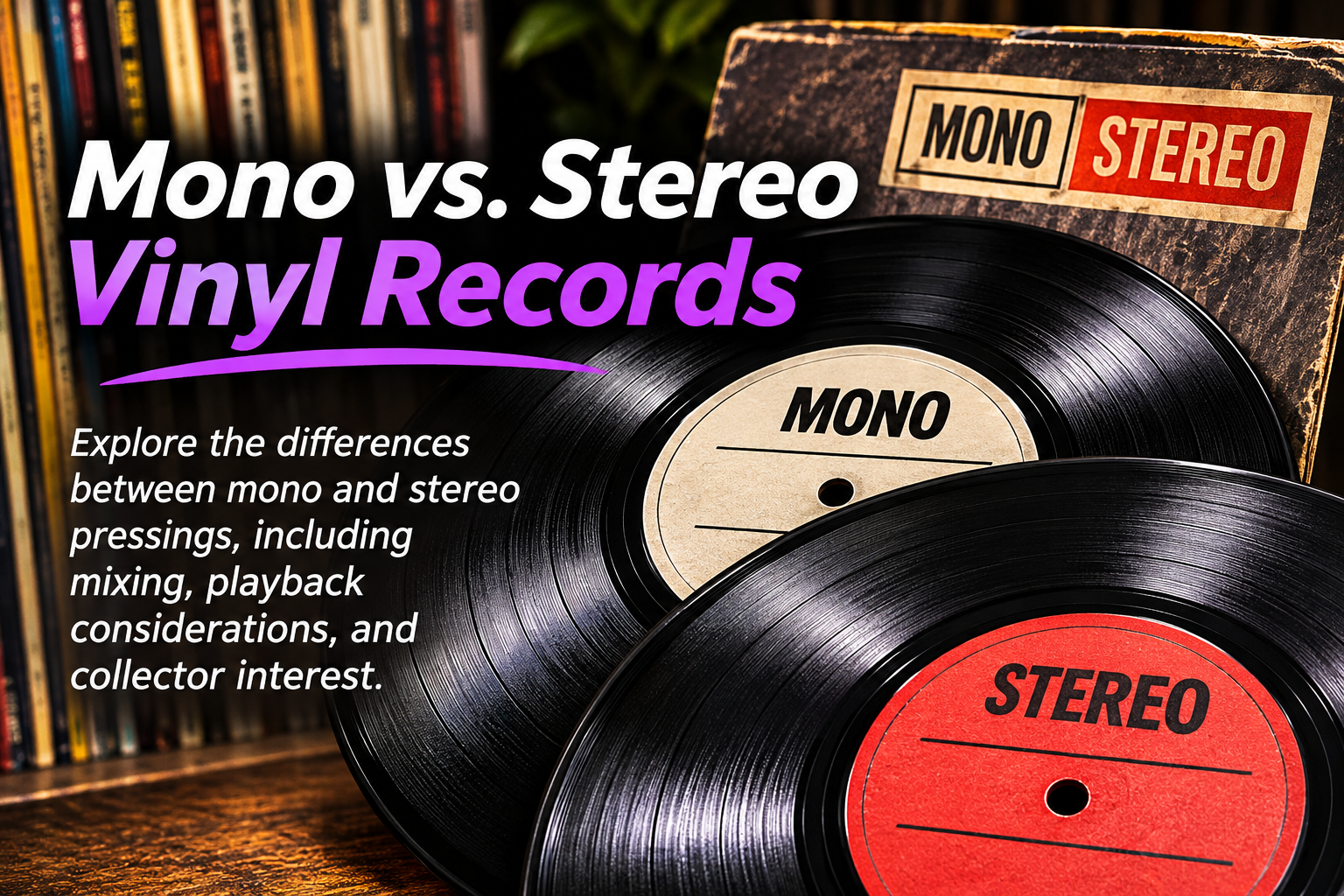
Two copies of the same vinyl album can look almost identical yet deliver noticeably different listening experiences. One may be a mono pressing, while the other is stereo. For collectors, understanding that distinction can help explain differences in sound, manufacturing history, and market value.
Mono and stereo records are not simply different playback settings. They can contain different mixes of the same recordings, sometimes prepared separately by engineers and producers.
This guide explains how mono and stereo vinyl records differ, how to identify them, what equipment considerations matter, and why certain pressings attract collector interest.
What Is a Mono Vinyl Record?
Mono, short for monophonic, refers to audio presented as a single channel. In a mono recording or mix, the musical elements are combined into one audio signal rather than being distributed between separate left and right channels.
When reproduced through a properly configured two-speaker system, a mono signal generally produces the same program information through both speakers.
Mono was the dominant format for commercial records during much of the early history of recorded music, including many important jazz, blues, rock, and pop releases.
Some classic albums were originally produced with mono playback as their primary intended format.
What Is a Stereo Vinyl Record?
Stereo, short for stereophonic, uses two audio channels, commonly identified as left and right.
These channels can contain different musical information, allowing instruments, vocals, and other sounds to be positioned across a perceived soundstage.
For example, a stereo mix might place a guitar predominantly in the left channel while another instrument appears more strongly in the right.
Stereo LPs became increasingly common during the late 1950s and 1960s and eventually became the standard for most commercial album releases.
Mono vs. Stereo: The Main Differences
- Audio channels: Mono uses one program channel, while stereo uses two.
- Sound presentation: Mono presents a unified signal, while stereo can create a sense of width and separation.
- Mixing decisions: Mono and stereo editions may have different balances, effects, edits, or instrument placement.
- Playback: Both formats can be played on appropriate modern equipment, although cartridge and stylus compatibility matter.
- Collector interest: Certain mono or stereo editions may be more desirable depending on the album, mix, rarity, and condition.
Why Mono and Stereo Mixes Can Sound Different
One of the most important things collectors should understand is that a mono version of an album may not simply be a stereo recording combined into one channel.
During the 1960s, some albums received separately prepared mono and stereo mixes. Engineers could make different decisions about vocal levels, instrument balance, reverberation, compression, and other production elements.
As a result, the two editions might sound noticeably different even though they contain performances from the same recording sessions.
Instrument Balance
An instrument that appears prominent in a mono mix might sit farther back in the stereo version, or vice versa.
Effects and Processing
Different mixes may contain variations in echo, reverb, equalization, or compression.
Editing Differences
Some albums have documented differences in fades, effects, or edits between mono and stereo releases.
Why Some Collectors Prefer Mono Pressings
Many collectors appreciate mono records because certain albums were originally mixed with mono playback as a major priority.
For some releases, the mono version represents a historically important presentation of the recording.
Collectors may also prefer the balance or overall character of a particular mono mix.
However, mono is not automatically superior to stereo. The quality of a pressing depends on the recording, mix, mastering, manufacturing, and condition of the individual record.
Why Some Collectors Prefer Stereo Pressings
Stereo records can provide a sense of space and separation that is not present in a conventional mono presentation.
Listeners may appreciate hearing individual instruments positioned across the soundstage, particularly when the stereo mix was carefully designed.
Some albums were recorded and mixed primarily for stereo, making the stereo edition the more representative version of the original production.
Ultimately, preferences vary by album and listener.
How to Identify a Mono Vinyl Record
The easiest starting point is to inspect the record sleeve and center label.
Many historical releases clearly identify their format with words such as MONO, MONOPHONIC, STEREO, or STEREOPHONIC.
However, not every pressing is clearly marked, and packaging can sometimes be misleading.
Check the Album Cover
Some record companies used different sleeve designs, banners, or catalog prefixes to distinguish mono and stereo editions.
Examine the Center Label
Look for format descriptions, catalog numbers, and manufacturing information printed directly on the record.
Compare Catalog Numbers
During certain periods, record labels assigned different catalog numbers or prefixes to mono and stereo versions of the same album.
These conventions varied by label and release period, so the exact numbering system must be researched.
Inspect the Runout Area
Matrix and runout markings can help identify the exact pressing, particularly when the sleeve and label information are incomplete.
Our
explains how to examine these markings.
Can You Play Mono Records on a Stereo Turntable?
Many mono vinyl LPs can be played using modern stereo turntable equipment, provided the cartridge and stylus are suitable for the record.
However, the age and physical format of the disc matter.
Modern microgroove mono LPs are different from older coarse-groove 78 RPM records, which generally require a different stylus size and appropriate playback equipment.
Some early mono cartridges and older playback systems are not suitable for stereo records because of differences in groove movement and cartridge compliance.
Collectors using vintage equipment should verify compatibility before playing unfamiliar records.
Do You Need a Special Cartridge for Mono Records?
A dedicated mono cartridge is not essential for every collector.
Many modern stereo cartridges can reproduce mono LPs effectively, especially when the system includes a properly implemented mono playback option.
Depending on the equipment, combining the left and right signals may help reduce certain types of noise on mono records.
Dedicated mono cartridges are also available, but their designs and compatibility vary.
Before purchasing one, consider the records you own, the cartridge’s electrical and mechanical design, and the manufacturer’s recommendations.
What Is a Mono Switch?
A mono switch combines the left and right playback channels into a single mono signal.
On suitable equipment, this can be useful when playing mono LPs with a stereo cartridge.
It may reduce some unwanted noise that differs between the channels.
However, a mono switch cannot repair damaged grooves or make an inferior pressing sound perfect.
It also does not transform a stereo mix into an original dedicated mono mix.
What Is a Fold-Down Mono Mix?
A fold-down is created by combining the left and right channels of a stereo mix into a single mono channel.
This differs from a dedicated mono mix, which may have been prepared independently using different mixing decisions.
Fold-downs can sound similar to the stereo source in some circumstances, but they may also produce changes in balance or phase-related effects.
For collectors, identifying whether a mono release uses a dedicated mix or a fold-down can be an important part of researching its history.
Are Mono Vinyl Records More Valuable?
Sometimes, but not always.
Some original mono pressings are highly collectible because of their scarcity, historical significance, or distinctive mixes.
Other mono releases are relatively common and may sell for modest prices.
Likewise, certain stereo first pressings can command substantial premiums.
Value depends on the exact edition, condition, demand, scarcity, and documented sales history.
Our
How Much Are My Old Vinyl Records Worth?
guide explains these factors in more detail.
Mono and Stereo First Pressings
During the transition from mono to stereo, record labels sometimes released albums in both formats.
Consequently, an album may have legitimate first pressings in mono and stereo, each with its own catalog number and manufacturing variations.
The term first pressing does not necessarily identify a single universal edition.
For a detailed explanation, read our
First Pressing vs. Reissue Guide
.
Can You Tell Mono From Stereo by Looking at the Grooves?
Not reliably through ordinary visual inspection.
Mono and stereo microgroove records use different groove modulation principles, but these differences are not normally identifiable simply by looking at the record surface.
Record labels, catalog numbers, runout inscriptions, and documented release information are much more practical identification tools.
Common Mono vs. Stereo Identification Mistakes
- Assuming every mono pressing is older than every stereo pressing.
- Believing mono always sounds better than stereo.
- Assuming a mono release necessarily contains a dedicated mono mix.
- Using album cover artwork as the only identification clue.
- Ignoring catalog numbers and matrix markings.
- Assuming all vintage cartridges are compatible with stereo records.
- Confusing an original mono pressing with a modern mono reissue.
- Assuming mono records are automatically more valuable.
A Practical Mono vs. Stereo Identification Checklist
Before identifying the format and edition of a record, check the following details:
- Mono or stereo wording on the sleeve.
- Format information on the center label.
- Catalog number and label prefix.
- Matrix and runout inscriptions.
- Country of manufacture.
- Approximate release date.
- Known mono and stereo variations.
- Documented mixing and mastering information.
Frequently Asked Questions
Is mono better than stereo for vinyl records?
Neither format is universally better. Some albums have highly regarded dedicated mono mixes, while others were designed primarily for stereo playback. Preferences depend on the recording and listener.
Can a modern turntable play mono records?
Most modern turntables equipped with an appropriate stereo cartridge can play conventional mono microgroove LPs. Older record formats may require specialized equipment.
Are mono records always original pressings?
No. Mono records have been reissued for decades, and modern releases may also use mono mixes.
Why do some albums have different mono and stereo mixes?
Historically, engineers sometimes prepared separate mixes for each format, resulting in differences in balance, effects, edits, or overall presentation.
Are stereo records more valuable than mono records?
Not necessarily. Market value depends on the specific release, rarity, condition, and collector demand rather than the format alone.
Final Thoughts on Mono vs. Stereo Vinyl Records
Mono and stereo vinyl records represent different approaches to presenting recorded sound. For some albums, the distinction is subtle. For others, the mixes can sound remarkably different.
Understanding the format, mastering, manufacturing history, and exact pressing can help collectors make more informed decisions.
Whether you prefer the unified presentation of mono or the spatial separation of stereo, the most important consideration is finding a well-preserved pressing of a mix you enjoy.
For additional research, explore our
Vinyl Record Identification Guide
and
.
Discover What Your Vinyl Records Are Worth
Once you’ve identified whether your record is a mono or stereo pressing, KlassicVinyl can help you research condition-based Discogs pricing and comparable eBay listings to better understand its potential market value.
New members receive 2 free record searches!