What Makes a Vinyl Record Rare and Valuable?
Some vinyl records are worth only a few dollars, while others can command hundreds or even thousands. Two copies of the same album may look nearly identical but have dramatically different collector values.
What makes one record desirable and another relatively common? The answer usually involves a combination of scarcity, demand, pressing history, condition, and unusual manufacturing details.
Understanding these factors can help collectors recognize interesting records and research their potential market value.
1. Scarcity: How Many Copies Exist?
Scarcity is one of the most important factors in vinyl collecting. Records manufactured in small quantities may be difficult to locate decades after their original release.
However, scarcity alone does not guarantee value. A record must also attract collector interest.
Some rare records remain inexpensive because relatively few people want them. Others become highly sought after because of their music, historical significance, or connection to a particular artist.
2. Original Pressings and Early Releases
Collectors frequently seek early pressings of historically important albums.
These editions may feature original label designs, early mastering cuts, unique packaging, or manufacturing characteristics that distinguish them from later versions.
But an original pressing is not automatically the most valuable edition.
Some later releases, audiophile editions, and unusual variations can attract greater demand than common original pressings.
To determine which version you own, examine the record label, catalog number, and runout markings.
For detailed instructions, read our Guide to Identifying Vinyl Record Pressings.
3. Promotional and Demonstration Records
Promotional records were distributed to radio stations, reviewers, retailers, and industry professionals to promote upcoming releases.
Some promotional editions were manufactured in limited quantities and feature unique labels, packaging, or recordings.
Collectors may encounter:
- White-label promotional records
- Radio station demonstration copies
- Promotional-only mixes or edits
- Special advance releases
- Records with promotional stamps or stickers
Not every promotional copy is rare. Some were distributed widely, and a promotional sticker on an ordinary jacket does not necessarily indicate a unique pressing.
4. Limited Editions and Special Releases
Record companies sometimes release albums in limited quantities, using special packaging, numbered editions, or distinctive vinyl colors.
Examples include:
- Numbered limited editions
- Special colored-vinyl releases
- Exclusive regional editions
- Special Record Store Day releases
- Box sets and collector packages
Limited production can increase collector interest, particularly when demand exceeds the number of available copies.
However, modern limited editions are not automatically valuable. Their market prices depend on actual collector demand and availability.
5. Manufacturing Errors and Unusual Variations
Some records become collectible because of manufacturing variations or mistakes.
These may include incorrect labels, alternate artwork, unusual mixes, withdrawn covers, or production errors.
Examples of potentially collectible variations include:
- Misprinted album covers
- Incorrect track listings
- Withdrawn artwork
- Unusual label variations
- Accidental alternate mixes
- Documented manufacturing mistakes
The important word is documented. An unusual-looking record is not necessarily a valuable error.
Collectors should compare their copy with reliable release information before assuming that a variation is rare.
6. The Importance of Record Condition
Condition can have a major effect on the value of a collectible record.
Collectors commonly use grading terms such as Mint, Near Mint, Very Good Plus, Very Good, Good, and Poor.
These grades describe the physical condition of the vinyl and, separately, the record’s packaging.
A rare pressing in heavily worn condition may be worth considerably less than a clean copy of the same edition.
Surface scratches, groove wear, warping, noise, and damaged packaging can all affect desirability.
Always evaluate the vinyl and jacket separately when researching a record’s condition.
7. Collector Demand Changes Over Time
Vinyl record values are influenced by changing collector interests.
Demand may increase when an artist becomes more popular, a particular genre attracts new listeners, or an historically significant release receives renewed attention.
Interest in jazz, early rock, soul, punk, psychedelic music, and other genres can vary considerably between individual releases.
Market values are not fixed. A record that attracted strong prices several years ago may have a different market value today.
8. Country of Manufacture and Pressing Plants
The country where a record was manufactured can sometimes influence collector demand.
Different countries may have released an album with unique artwork, track listings, mastering cuts, or record labels.
Pressing plants can also be important, particularly when collectors seek specific mastering or manufacturing variations.
These details are often identified through catalog numbers, label information, and runout markings.
9. Why Asking Prices Can Be Misleading
One of the most common mistakes in vinyl valuation is assuming that an online asking price represents what a record is actually worth.
A seller may list a record for hundreds of dollars, but that does not mean buyers are willing to pay that amount.
When researching values, compare multiple listings and, where available, completed sales for the same pressing and similar condition.
Make sure the records being compared are genuinely the same edition. A rare pressing and a common reissue can have very different prices.
10. How to Research a Rare Vinyl Record
If you believe you own an unusual or collectible record, begin by gathering its identifying details.
- Artist and album title
- Record label and catalog number
- Matrix and runout markings
- Country of manufacture
- Label and packaging variations
- Vinyl and jacket condition
Use this information to identify the exact release before comparing market prices.
Our Vinyl Identification Guide explains how to examine these details and distinguish different pressings.
Four Legendary Rare Vinyl Records
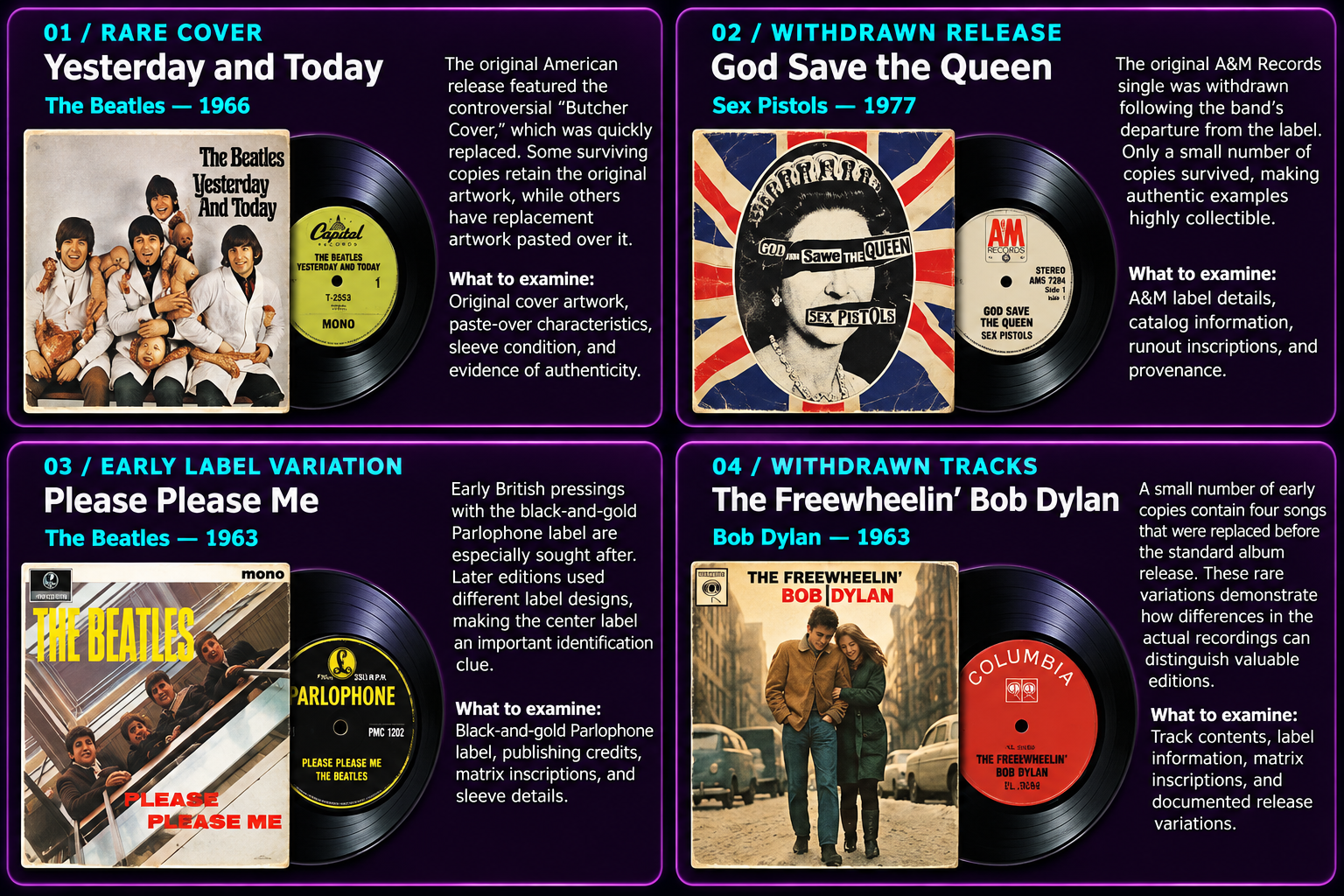
Some records have become legendary among collectors because of withdrawn releases, unusual artwork, early manufacturing variations, or recordings that were changed before widespread distribution. These four examples demonstrate why identifying the exact edition matters.
Yesterday and Today
The original American release featured the controversial “Butcher Cover,” which was quickly replaced. Some surviving copies retain the original artwork, while others have replacement artwork pasted over it.
What to examine: Original cover artwork, paste-over characteristics, sleeve condition, and evidence of authenticity.
God Save the Queen
The original A&M Records single was withdrawn following the band’s departure from the label. Only a small number of copies survived, making authentic examples highly collectible.
What to examine: A&M label details, catalog information, runout inscriptions, and provenance.
Please Please Me
Early British pressings with the black-and-gold Parlophone label are especially sought after. Later editions used different label designs, making the center label an important identification clue.
What to examine: Black-and-gold Parlophone label, publishing credits, matrix inscriptions, and sleeve details.
The Freewheelin’ Bob Dylan
A small number of early copies contain four songs that were replaced before the standard album release. These rare variations demonstrate how differences in the actual recordings can distinguish valuable editions.
What to examine: Track contents, label information, matrix inscriptions, and documented release variations.
Discover What Your Vinyl Record May Be Worth
Rare records can be fascinating discoveries, but accurate identification and realistic market comparisons are essential.
KlassicVinyl.com helps collectors research condition-based record prices and comparable eBay listings.
Remember: rarity, demand, condition, and pressing identification all contribute to a record’s potential value.
Research Your Vinyl Record’s Value
Identified an unusual pressing or rare release? Explore condition-based prices and comparable listings with KlassicVinyl.