How to Identify Promotional Vinyl Records
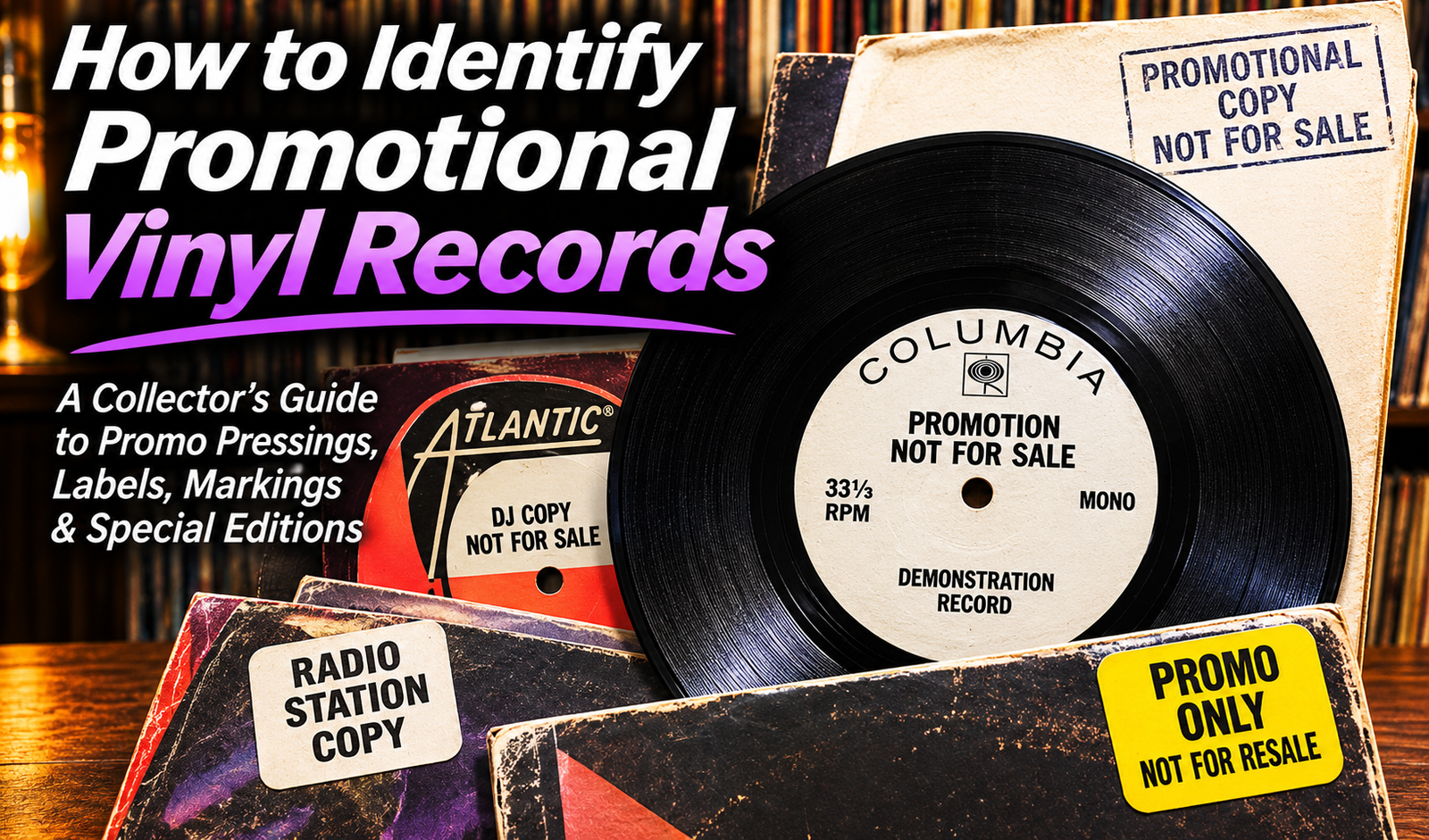
While searching through a collection of vintage records, you may encounter an album with a white center label, a gold promotional stamp, or a sticker reading “Not for Sale.” These markings often indicate that the record was originally distributed for promotional purposes rather than ordinary retail sale.
Promotional vinyl records, commonly called promo records, were distributed to radio stations, DJs, reviewers, retailers, and other industry professionals to generate publicity for a recording.
Some promotional records are highly collectible, while others are relatively common. Knowing how to identify them can help you distinguish a genuine promotional edition from an ordinary retail copy and understand whether the differences might affect its value.
What Is a Promotional Vinyl Record?
A promotional vinyl record is a recording distributed primarily to encourage publicity, radio airplay, reviews, or commercial interest in an artist or release.
Record companies frequently produced promotional copies before or around the time of a commercial release. Some were manufactured with special labels, while others were ordinary retail pressings marked or packaged for promotional distribution.
Promotional records were commonly supplied to:
- Commercial and college radio stations
- Disc jockeys and music programmers
- Music journalists and reviewers
- Record store buyers and distributors
- Concert promoters and industry representatives
- Clubs and dance-music DJs
These records sometimes feature alternate mixes, special edits, unusual packaging, or advance-release information that makes them particularly interesting to collectors.
1. White-Label Promotional Records
One of the best-known promotional formats is the white-label promo. Instead of using the standard commercial label design, the record may feature a plain or specially printed white label.
White-label promos were especially common among certain record companies during the 1960s and 1970s, although practices varied by company, country, and period.
Common White-Label Promo Features
- White or lightly colored center labels
- Printed promotional or demonstration notices
- Special catalog numbers or prefixes
- Mono and stereo versions of the same recording
- Radio programming or suggested airplay information
- Different typography from commercial editions
However, not every white-label record is an official promotional pressing. Plain white labels may also appear on test pressings, independent releases, private pressings, and unofficial records.
Collector Tip: A white label is a clue, not proof. Always compare the catalog number, runout markings, label typography, and documented release information before identifying a record as an official promotional edition.
2. Promotional Stamps on Album Covers
Many promotional albums were distributed in standard commercial sleeves with special markings added to the packaging.
Common promotional stamps include:
- Promotion Not for Sale
- For Promotional Use Only
- Demonstration Copy
- Not for Resale
- Property of Record Company
- Loaned for Promotional Use
Gold or silver foil stamps were sometimes applied to the back of an album jacket. Other records received ink stamps or printed promotional stickers.
These markings may indicate genuine promotional distribution, but they do not necessarily mean the vinyl inside differs from the regular retail pressing.
Stamped Promo vs. Dedicated Promo Pressing
A stamped promo may contain an ordinary retail record placed inside a promotionally marked sleeve. A dedicated promotional pressing may have its own center label, catalog number, mastering, or track configuration.
This distinction matters because collectors may value the two editions differently.
3. Radio Station and DJ Promotional Copies
Radio stations received promotional records so programmers and DJs could evaluate new music before deciding whether to play it.
Some records were specifically manufactured for radio use, while others were commercial copies distributed through promotional channels.
Signs of a Radio Station Copy
- Station call letters written or stamped on the sleeve
- Radio station inventory stickers
- Suggested tracks or airplay instructions
- Handwritten song ratings or programming notes
- Timing strips listing track lengths
- Promotional labels or catalog numbers
A station’s handwritten markings can help establish a record’s history, but they may also reduce its cosmetic condition. Their effect on value depends on the release and collector interest.
4. Promotional 45 RPM Singles
Promotional 45 RPM singles were widely used to introduce new songs to radio stations and industry professionals.
Some promo singles featured the same recording on both sides, sometimes with one side in mono and the other in stereo.
Others contained different edits, alternate mixes, or a version tailored for radio broadcasting.
Why Promo Singles Can Be Collectible
- Some were distributed before the commercial release.
- They may contain radio edits unavailable elsewhere.
- Certain versions were manufactured in limited quantities.
- Some feature unreleased or alternate recordings.
- Promotional label variations can interest specialist collectors.
However, many promotional singles were produced in substantial numbers. A promotional designation alone does not establish rarity.
For information about record speeds and formats, visit our 33, 45 & 78 RPM Records Explained guide.
5. Promotional Albums and Advance Copies
Record companies also distributed full-length promotional albums to journalists, radio stations, retailers, and other industry contacts.
These could be standard commercial pressings with promotional markings or specially manufactured editions.
Some advance copies included:
- Temporary or generic sleeves
- Advance-release stickers
- Press information sheets
- Promotional photographs or biographies
- Special track listings
- Unique label designs
An advance promotional copy can be especially interesting when it contains an earlier version of an album, different track sequencing, or material that was changed before the commercial release.
6. Promotional Records with Alternate Mixes
Some of the most desirable promotional records contain audio that differs from the standard commercial release.
Possible variations include:
- Radio edits with shorter running times
- Extended dance mixes
- Alternate vocal performances
- Instrumental versions
- Different mono or stereo mixes
- Clean versions prepared for radio airplay
- Early mixes that were later revised
A promotional record containing a genuinely unique recording may attract more collector interest than one that duplicates the regular commercial edition.
For more information about mixing differences, read our Mono vs. Stereo Vinyl Records guide.
7. Promotional Records vs. Test Pressings
Promotional records and test pressings are not the same thing, although they are sometimes confused.
A test pressing is generally manufactured to evaluate a record before full production. It may be used to assess audio quality, manufacturing defects, or mastering results.
A promotional pressing is primarily intended to publicize a recording or support its commercial release.
| Feature | Promotional Record | Test Pressing |
|---|---|---|
| Primary purpose | Publicity and promotion | Production evaluation |
| Typical recipient | Radio, press, DJs, retailers | Label, artist, mastering or production staff |
| Labels | Promo labels or marked retail labels | Often generic or test-pressing labels |
| Packaging | Commercial or special promotional sleeve | Often plain or temporary sleeve |
| Collectibility | Varies by edition and demand | Varies by rarity, significance and demand |
Because both formats can have plain labels, identification should rely on documented manufacturing details rather than appearance alone.
8. How to Verify a Genuine Promotional Pressing
When researching a possible promotional record, the goal is to determine whether the record matches a documented promotional edition.
- Examine the center label. Look for promotional wording, unusual colors, and special typography.
- Check the sleeve. Note promotional stamps, stickers, and advance-release information.
- Record the catalog number. Include any unusual prefixes or suffixes.
- Inspect the runout markings. Compare etched and stamped numbers with documented pressings.
- Compare track listings. Look for different mixes, edits, or song configurations.
- Identify the country. Promotional practices varied between markets.
- Research documented examples. Compare photographs and release information from reliable sources.
If the record has a promotional sleeve but ordinary retail labels, research whether the manufacturer distributed that exact combination.
Our Vinyl Matrix Numbers guide explains how runout markings can help identify different pressings.
9. Can Promotional Markings Be Added Later?
Yes. Stamps, stickers, and handwritten notes can be added to sleeves after manufacture. Some were applied legitimately during promotional distribution, while others may have been added by later owners.
A sticker reading “Promo Only” is not sufficient evidence that the record is an official promotional pressing.
Look for consistency between the markings, record label, catalog number, release period, and documented examples.
If the edition is expensive, verify the details before purchasing. Our How to Spot Counterfeit Vinyl Records guide offers additional advice on evaluating questionable releases.
10. Are Promotional Vinyl Records Rare?
Some promotional records are rare, but many are not.
Record companies sometimes distributed large numbers of promotional copies to radio stations, retailers, and music industry professionals.
Other promotional editions were produced in much smaller quantities, especially those intended for limited industry circulation or special events.
Rarity may depend on:
- The number of copies originally manufactured
- How many examples survive
- Whether the recording was commercially released
- The artist’s popularity and collector following
- Unique mixes or unreleased material
- The condition of surviving copies
A scarce promotional record may still have limited market value if few collectors want it. Scarcity and demand must be considered separately.
11. Are Promotional Records More Valuable Than Retail Copies?
Sometimes, but not always. Promotional copies can command higher prices when they feature distinctive labels, scarce mixes, early-release configurations, or other desirable characteristics.
However, a common promotional pressing may sell for about the same amount as a regular retail edition—or even less if its condition is poor.
Collectors should compare actual sales of the same promotional edition rather than assuming that every promo has a premium value.
Factors That Influence Promotional Record Values
- Artist and recording popularity
- Specific promotional pressing variation
- Availability of alternate or unreleased audio
- Record and sleeve condition
- Original promotional inserts or packaging
- Documented scarcity
- Recent comparable sales
Learn more in our How Much Are My Old Vinyl Records Worth? guide.
12. How Condition Affects Promotional Record Value
Promotional records were often handled extensively by radio stations and DJs. Some were played repeatedly, marked for programming, or stored in crowded station libraries.
As a result, condition can vary considerably.
Inspect the vinyl for scratches, groove wear, warping, and surface damage. Examine the sleeve for writing, stickers, seam splits, and other wear.
Some collectors appreciate authentic radio-station markings as part of a record’s history. Others prefer cleaner examples. The effect on market value depends on the specific release.
For grading guidance, visit our Vinyl Record Grading Guide.
13. Where to Find Promotional Vinyl Records
Promotional records can appear in many of the same places as ordinary vinyl albums and singles.
- Independent record stores
- Record conventions and collector shows
- Estate sales and private collections
- Former radio station collections
- Online record marketplaces
- Specialist dealers in rare vinyl
When buying online, request clear photographs of the center labels, promotional markings, catalog numbers, and sleeve condition.
For expensive purchases, ask the seller to confirm the runout information and whether the record contains any unique mixes or tracks.
14. Common Mistakes When Identifying Promotional Records
- Assuming every white label is a promo. Test pressings and other releases can also have white labels.
- Assuming a gold stamp proves a unique pressing. The record inside may be an ordinary retail copy.
- Ignoring catalog and matrix numbers. These may be essential for confirming an edition.
- Assuming every promo is rare. Some were distributed widely.
- Confusing test pressings with promotional records. They serve different purposes.
- Overlooking condition. Heavy radio or DJ use can significantly affect playback.
- Using ordinary retail sales to estimate a promo’s value. Compare the exact edition whenever possible.
Promotional Vinyl Identification Checklist
Use this checklist when examining a possible promotional record.
- Check for promotional wording on the center label.
- Look for white-label or other distinctive label designs.
- Inspect the sleeve for stamps and promotional stickers.
- Record the complete catalog number.
- Examine the runout matrix information.
- Compare the track listing with the retail release.
- Check for alternate mixes or radio edits.
- Identify the country and approximate release period.
- Look for original promotional inserts.
- Compare the record with documented promotional editions.
- Evaluate the vinyl and sleeve condition separately.
- Research comparable sales of the exact pressing.
Frequently Asked Questions
What does “Promotion Not for Sale” mean on a record?
It generally indicates that the record was originally intended for promotional distribution rather than ordinary retail sale. It does not automatically mean the pressing is rare or different from the retail edition.
Are white-label promotional records valuable?
Some are valuable, particularly scarce or historically significant editions. Others are common. Value depends on the artist, exact pressing, condition, and collector demand.
Is a gold-stamped record a promotional pressing?
A gold stamp may indicate promotional distribution, but the vinyl itself could be identical to a standard retail pressing. Verify the label and runout details.
What is the difference between a DJ copy and a regular record?
A DJ copy may have been distributed for radio or club use and can feature special markings, mixes, edits, or labels. Some DJ copies are otherwise identical to retail records.
Can promotional records have different music?
Yes. Some contain radio edits, alternate mixes, instrumentals, extended versions, or recordings not included on the standard commercial release.
Are promotional records the same as test pressings?
No. Promotional records are intended to publicize music, while test pressings are generally made to evaluate a recording before mass production.
How can I tell whether a promotional record is authentic?
Compare the center label, promotional markings, catalog number, runout inscriptions, packaging, and track information with documented examples of the specific release.
Can promotional records be collected and resold?
Promotional records are widely bought and sold in secondary collector markets. However, their legal status can depend on jurisdiction and the circumstances of distribution; a printed “Not for Sale” notice does not, by itself, resolve every ownership or resale question.
Final Thoughts
Promotional vinyl records offer a fascinating look into how music was marketed and distributed. White labels, promotional stamps, radio-station markings, and unusual mixes can reveal details that are absent from ordinary retail editions.
For collectors, the most important lesson is to identify the exact record rather than relying on promotional markings alone. A genuine promotional edition may be highly desirable, but its value depends on its particular characteristics, condition, scarcity, and demand.
Continue exploring our Vinyl Record Identification Guide, How to Identify Rare Vinyl Records, and other Collector Guides.
Wondering What Your Promotional Records Are Worth?
Once you’ve identified a promotional pressing, the next step is comparing its market value with similar editions.
At KlassicVinyl.com, you can quickly compare Discogs record values by condition alongside comparable eBay listings. New registered members receive 2 free record searches.