How to Identify a Vinyl Record Pressing Plant
Two copies of the same vinyl album can have identical covers, catalog numbers, and label designs yet come from different manufacturing facilities. Identifying the pressing plant can help collectors distinguish otherwise similar editions and better understand a record’s production history.
Vinyl pressing plant identification involves examining manufacturing clues such as runout inscriptions, stamped symbols, label markings, and documented release variations. Some records are relatively easy to trace, while others require careful research.
What Is a Vinyl Record Pressing Plant?
A pressing plant is a manufacturing facility where vinyl records are physically produced. During production, prepared metal stampers are used to press heated vinyl material into records containing the grooves that reproduce recorded sound.
Pressing plants may manufacture records for many different record labels. As a result, albums released by the same label can originate from multiple factories, sometimes during the same release period.
Identifying the manufacturing facility can help establish which version of an album you own, particularly when several plants produced similar copies.
Where to Find Pressing Plant Identification Marks
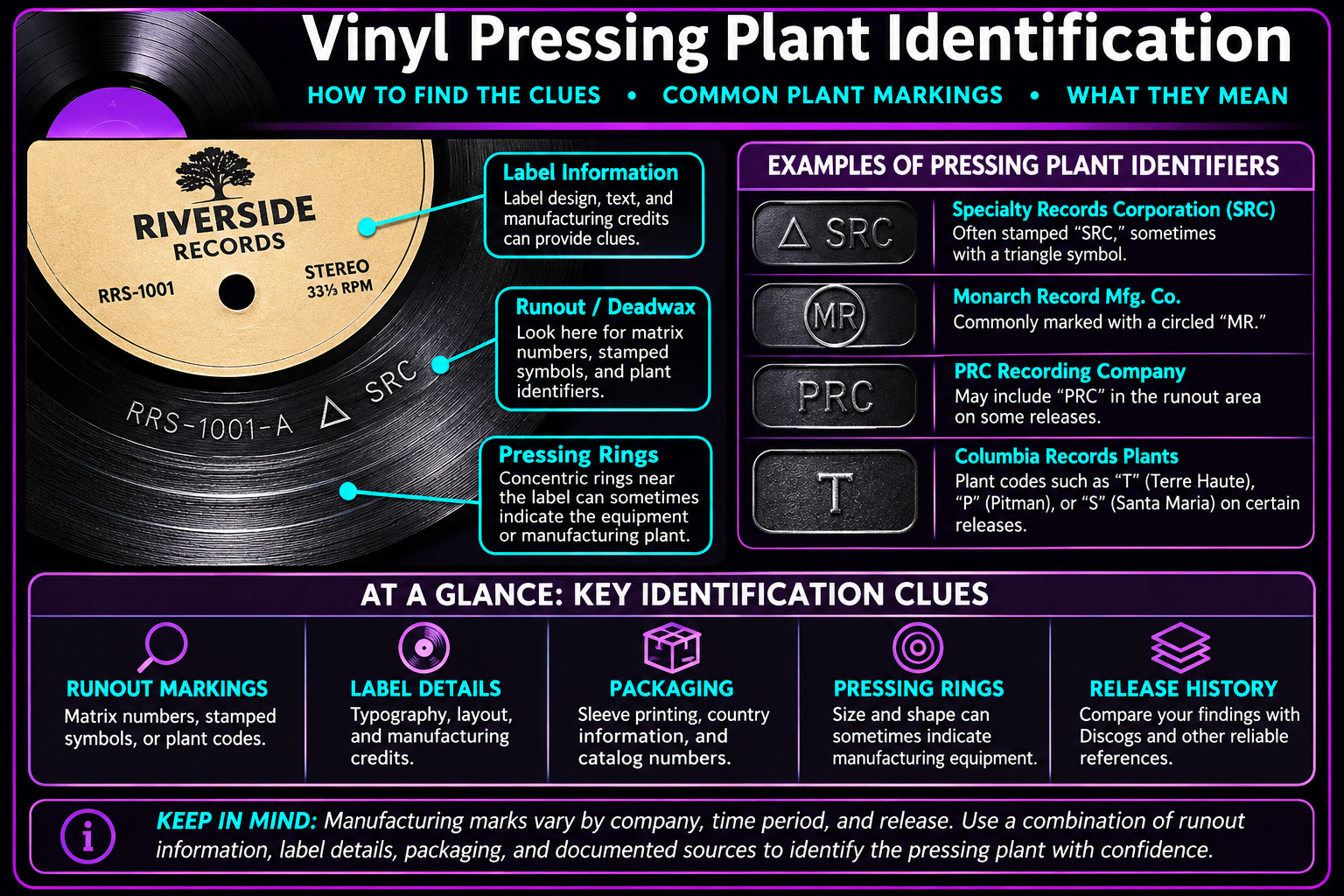
The most useful clues often appear in the runout area, also called the deadwax. This is the smooth section between the final music groove and the center label.
Pressing plants sometimes used distinctive symbols, letters, numbers, or stamped identifiers. However, not every marking in the deadwax identifies a pressing plant. Some relate to mastering, lacquer cutting, plating, or other manufacturing stages.
To examine your record:
- Hold the disc carefully by its edges and center label.
- Use bright, indirect lighting to inspect the runout area.
- Rotate the record slowly to locate all inscriptions.
- Write down every letter, number, and symbol from both sides.
- Note which markings are stamped and which appear hand-etched.
- Compare the complete inscriptions with documented release variations.
Our guide to reading vinyl matrix numbers explains how to locate and interpret common runout information.
Common Types of Pressing Plant Clues
Stamped Symbols and Letters
Some manufacturing facilities used recognizable stamped or etched identifiers. These may appear as single letters, groups of characters, or distinctive symbols.
The meaning of a mark depends on the manufacturer and time period. A symbol associated with one plant in a particular era may have a different meaning elsewhere.
Matrix and Runout Patterns
Pressing plants sometimes followed characteristic inscription formats or used particular combinations of identifiers.
However, a matrix number alone does not always reveal where a record was pressed. Metal parts could be manufactured at one facility and used to press records at another.
Label Printing and Typography
Small differences in center-label printing can provide additional evidence. Collectors may examine text alignment, font styles, label rings, manufacturing credits, and other details.
These characteristics should be used alongside documented manufacturing information rather than treated as definitive proof.
Pressing Rings
Many vinyl records have one or more circular impressions around the center label. These are commonly called pressing rings.
Their size and shape can sometimes help distinguish manufacturing equipment or production practices. However, pressing-ring measurements alone rarely provide conclusive identification because different facilities may use similar machinery.
Examples of Documented Pressing Plant Identifiers
Some well-documented American pressing facilities used recognizable manufacturing identifiers. Examples include:
- Columbia Records pressing plants: Certain releases used plant-specific codes or characteristic markings associated with facilities such as Terre Haute, Pitman, and Santa Maria.
- Specialty Records Corporation: Some records manufactured by Specialty feature a distinctive stylized SRC logo in the runout area.
- Monarch Record Mfg. Co.: Many Monarch pressings carry a circled MR stamp, sometimes accompanied by additional manufacturing identifiers.
- PRC Recording Company: Some releases include plant-related markings that can help distinguish PRC-manufactured copies.
Can a Record Have More Than One Manufacturing Location?
Yes. Vinyl manufacturing involves several stages, and those stages do not necessarily occur at the same facility.
A recording might be mastered at one studio, have its lacquer cut at another facility, undergo metal plating elsewhere, and finally be pressed at a separate manufacturing plant.
This is why a mastering engineer’s signature or lacquer-cutting facility mark should not automatically be interpreted as a pressing-plant identifier.
How to Research a Pressing Plant
Begin with the complete runout inscriptions from both sides of the record. Then compare those markings with documented copies in reliable discographies and manufacturing references.
Discogs can be particularly useful because release entries often contain detailed matrix information, pressing-plant credits, and photographs of label variations. However, entries are community-contributed and may contain errors or incomplete information.
Check whether several characteristics agree, including the runout markings, center-label design, catalog number, country of manufacture, and sleeve details.
Does the Pressing Plant Affect Sound Quality?
Manufacturing quality can influence a record’s playback characteristics. Factors such as vinyl formulation, equipment condition, quality control, and handling can contribute to differences between individual copies.
However, the pressing plant is only one part of the process. Mastering choices, source material, lacquer cutting, and the condition of the particular record also influence the listening experience.
It would be inaccurate to assume that every record from one plant sounds better than every record from another.
Does the Pressing Plant Affect Record Value?
Sometimes. Collectors may prefer particular manufacturing variants because of scarcity, historical interest, or documented mastering differences.
For many common releases, however, identifying the pressing plant may have little effect on market value.
Condition, collector demand, and the exact edition remain important. Read our guide to rare and valuable vinyl records for a broader explanation.
Common Pressing Plant Identification Mistakes
- Assuming every runout symbol identifies a pressing plant.
- Confusing mastering facilities with record manufacturing plants.
- Using pressing-ring measurements as the only evidence.
- Ignoring markings on the second side of the record.
- Assuming all copies with the same catalog number came from one factory.
- Accepting undocumented online claims without comparing reliable examples.
A Practical Identification Checklist
Before deciding where a record was manufactured, confirm as many of the following details as possible:
- Complete matrix and runout inscriptions from both sides.
- Distinctive stamped or etched symbols.
- Center-label typography and layout.
- Catalog number and country information.
- Pressing-ring characteristics.
- Matching photographs and documented release history.
Pressing-plant identification works best when several independent clues point toward the same manufacturing facility.
For a broader introduction to identifying editions, visit our complete vinyl pressing identification guide.
Identified Your Pressing? Explore Its Value.
Once you’ve narrowed down the edition you own, KlassicVinyl can help you research condition-based Discogs pricing and comparable eBay listings to better understand its potential market value.