33, 45 & 78 RPM Records Explained
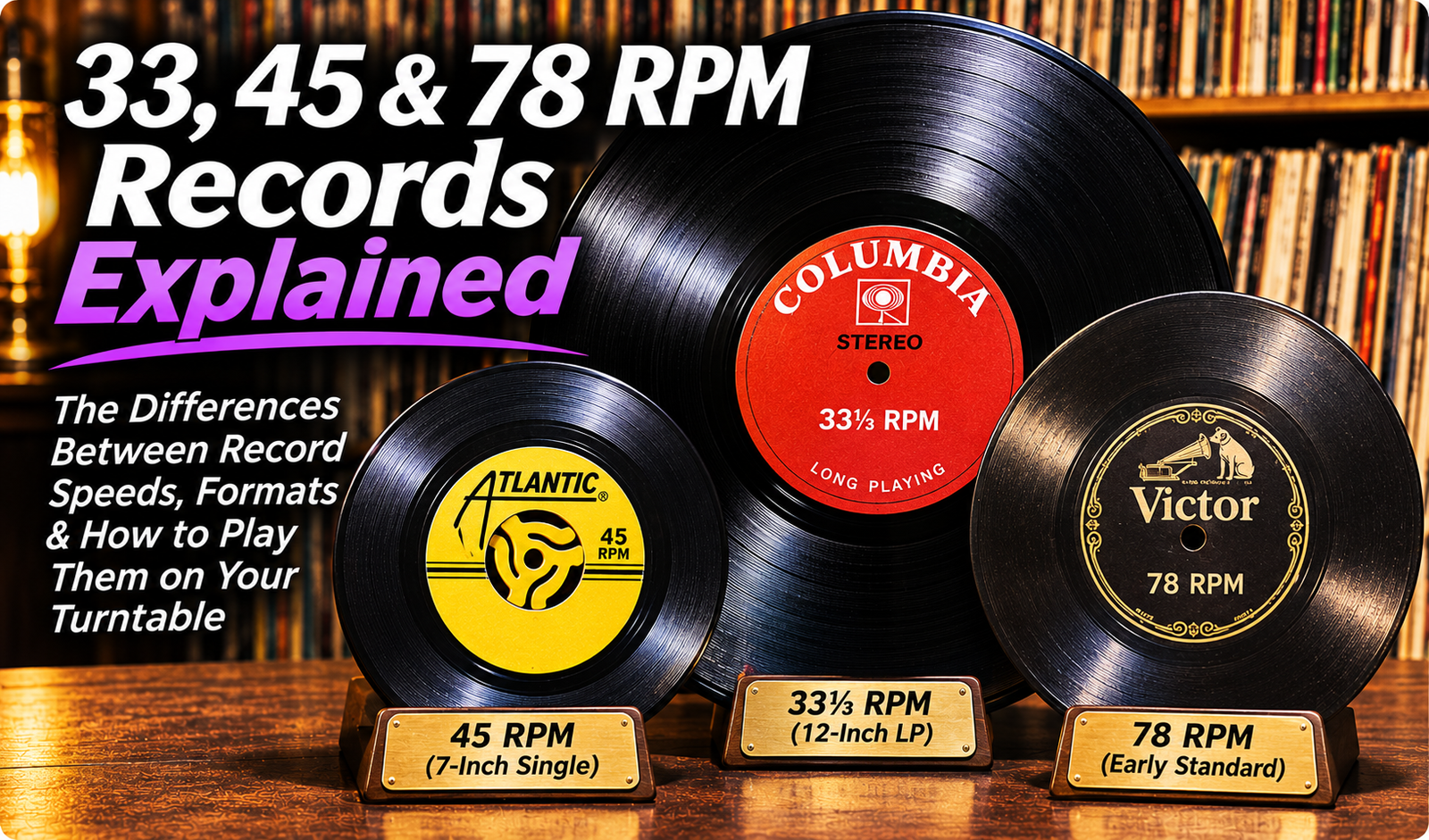
If you’ve spent time browsing a record store, you’ve probably noticed that vinyl records come in different sizes and play at different speeds. The most familiar are 33⅓, 45, and 78 RPM records, each representing an important chapter in the history of recorded music.
Although these numbers may seem confusing to new collectors, they simply describe how quickly a record rotates on a turntable. Understanding the differences can help you identify records, choose the correct playback equipment, and avoid damaging older recordings.
In this guide, we’ll explore the history, sizes, materials, playback requirements, and collecting considerations associated with all three formats.
What Does RPM Mean on a Vinyl Record?
RPM stands for revolutions per minute. It describes how many complete rotations a record makes in one minute while playing.
For example:
- 33⅓ RPM: The record makes approximately 33.33 revolutions per minute.
- 45 RPM: The record makes 45 revolutions per minute.
- 78 RPM: The record makes approximately 78 revolutions per minute.
Records are manufactured with grooves intended to be played at a particular speed. When played at the wrong speed, the music will sound too fast or too slow, and its pitch will change.
Quick Comparison: 33 vs. 45 vs. 78 RPM
| Feature | 33⅓ RPM | 45 RPM | 78 RPM |
|---|---|---|---|
| Common size | 12 inches | 7 inches | 10 inches |
| Typical format | LP album | Single or EP | Early single |
| Common material | Vinyl | Vinyl | Shellac |
| Typical playing time | Around 18–25 minutes per side | Around 3–5 minutes per side for singles | Around 3 minutes per side |
| Stylus | Microgroove | Microgroove | Usually a wider 78 stylus |
These are common combinations, not absolute rules. Some 12-inch records play at 45 RPM, some 7-inch records play at 33⅓ RPM, and historical 78 RPM discs were manufactured in several sizes and materials.
1. What Is a 33⅓ RPM Record?
The 33⅓ RPM long-playing record, commonly called an LP, became the standard format for full-length albums. Columbia introduced its modern microgroove LP format in 1948.
Unlike earlier shellac discs, vinyl LPs could hold substantially more recorded music on each side. This allowed listeners to enjoy complete albums without changing records every few minutes.
Characteristics of 33⅓ RPM Records
- Usually 12 inches in diameter
- Generally manufactured from vinyl
- Often contain multiple tracks per side
- Commonly provide around 18–25 minutes of music per side
- Use fine microgrooves designed for modern LP styli
- Frequently sold in full-size illustrated album jackets
Some albums contain much longer sides, although longer playing times can require compromises in cutting level or groove spacing.
The LP remains one of the most popular formats among collectors because it combines album artwork, substantial playing time, and the familiar experience of listening to an entire album.
2. What Is a 45 RPM Record?
The 45 RPM record became especially popular as a format for singles. RCA Victor introduced its 7-inch 45 RPM system in 1949.
The format was well suited to individual songs and became closely associated with jukeboxes, radio hits, and popular music throughout the 1950s, 1960s, and later decades.
Characteristics of 45 RPM Records
- Commonly 7 inches in diameter
- Usually manufactured from vinyl
- Often feature one song on each side
- May include a designated A-side and B-side
- Frequently have a large center hole, particularly on U.S. releases
- Can also appear as extended plays or 12-inch singles
Many 7-inch 45s have a large center hole that requires an adapter when played on a turntable with a standard small spindle. Other 45s have small center holes and do not require an adapter.
What Is an A-Side and B-Side?
On many singles, the A-side was the song selected for primary promotion, while the B-side featured another recording. Some B-sides later became popular or collectible in their own right.
Collectors sometimes seek particular singles because of rare B-sides, alternate mixes, promotional editions, or unusual label variations.
3. What Is a 78 RPM Record?
The 78 RPM record predates the modern vinyl LP and 45 RPM single. Commercial disc recordings using approximately this speed were widely distributed during the first half of the twentieth century.
Most traditional 78s were made from shellac-based compounds rather than the flexible vinyl used for modern records.
Shellac records are typically heavier, harder, and more brittle than vinyl. They can crack or shatter if dropped or handled carelessly.
Characteristics of Traditional 78 RPM Records
- Most commonly 10 inches in diameter, although other sizes exist
- Usually manufactured from shellac-based material
- Typically contain one recording per side
- Often provide around three minutes of music per side
- Have wider grooves than modern LPs and 45s
- Generally require a stylus designed for coarse-groove records
Important: Do not assume a traditional shellac 78 can be safely played using the same stylus as a modern vinyl LP. Its wider grooves normally require a dedicated 78 RPM stylus and compatible playback equipment.
Some later 78 RPM records were manufactured from vinyl, and early discs did not always rotate at precisely 78 RPM. The record’s construction and documented specifications should guide playback decisions.
4. Why Were Different Record Speeds Developed?
Record formats developed as manufacturers sought different balances between playing time, sound reproduction, manufacturing requirements, and consumer convenience.
Traditional 78 RPM records offered relatively short playing times. The development of fine-groove vinyl records made it possible to fit more music onto a disc.
The 33⅓ RPM LP became popular for albums, while the 45 RPM single was particularly successful for individual songs and jukebox playback.
Both modern formats remain in use, and 45 RPM is also common for certain audiophile albums and 12-inch singles.
5. Does 45 RPM Sound Better Than 33⅓ RPM?
A 45 RPM record can offer technical advantages under certain conditions. Faster rotation means more groove length passes beneath the stylus each second, which can give mastering engineers greater flexibility when cutting a recording.
This can help support strong dynamics and high-frequency reproduction, particularly when sufficient groove space is available.
However, 45 RPM does not automatically mean better sound quality. Mastering choices, source recordings, pressing quality, cartridge performance, and record condition all influence the listening experience.
A well-mastered 33⅓ RPM LP can sound excellent, while a poorly manufactured 45 RPM pressing may sound disappointing.
6. Can a 12-Inch Record Play at 45 RPM?
Yes. Although most 12-inch LP albums play at 33⅓ RPM, some 12-inch records are designed for 45 RPM playback.
These include dance singles, extended mixes, and certain audiophile album releases.
An album originally issued on one 33⅓ RPM LP may also be released as a two-record 45 RPM edition, allowing more groove space for the music.
Always check the center label or packaging before selecting the playback speed. Record diameter alone does not guarantee the correct RPM.
7. Can a 7-Inch Record Play at 33⅓ RPM?
Yes. While 7-inch records are strongly associated with 45 RPM singles, some were manufactured to play at 33⅓ RPM.
These may include extended-play releases, spoken-word recordings, or special editions designed to accommodate longer playing times.
A record’s size is therefore a useful clue, but not a definitive way to identify its playback speed.
8. How to Identify a Record’s Correct Speed
If you find a record without obvious playback instructions, several details can help identify its intended speed.
- Examine the center label. Look for 33⅓, 45, 78, LP, or other speed markings.
- Check the sleeve. Original packaging may provide playback instructions.
- Measure the diameter. Common sizes can help narrow the possibilities.
- Consider the material. A heavy, rigid shellac disc may be an older 78.
- Research the catalog number. Release databases may identify the correct format.
- Inspect the groove type. Traditional coarse-groove records differ from modern microgroove discs.
Do not experiment with an unknown, potentially fragile historical disc using an ordinary LP stylus. Identify its format before attempting playback.
Our Understanding Vinyl Record Labels guide explains how label details can help identify a specific edition.
9. Can Modern Turntables Play All Three Speeds?
Not every modern turntable supports all three speeds.
Many contemporary turntables offer 33⅓ and 45 RPM playback, while 78 RPM capability is less common.
To play traditional shellac 78s properly, you generally need:
- A turntable with an appropriate 78 RPM speed setting
- A compatible cartridge and dedicated 78 RPM stylus
- Suitable tracking force and tonearm setup
- A playback system capable of handling the recording’s characteristics
- Appropriate equalization for more accurate reproduction, particularly with older recordings
A turntable offering a 78 RPM speed setting does not necessarily include the stylus needed for safe shellac playback.
10. Why 78 RPM Records Need a Different Stylus
Modern vinyl LPs and 45s use relatively narrow microgrooves. Traditional shellac 78s generally have substantially wider grooves.
A modern LP stylus is usually too small to track a coarse-groove 78 correctly. It may ride too low in the groove, producing excessive noise or risking damage.
A dedicated 78 stylus has a larger tip designed for these wider grooves. However, historical groove dimensions vary, so especially valuable or unusual recordings may require specialist advice.
Never assume that changing the turntable speed is the only adjustment required.
11. How to Clean 33, 45, and 78 RPM Records
Proper cleaning depends on the record’s material, not simply its speed.
Cleaning Vinyl LPs and Singles
Modern vinyl records can be cleaned with suitable record-cleaning products and equipment designed for vinyl. A carbon-fiber brush can remove loose surface dust before playback.
For detailed instructions, read How to Clean Vinyl Records Safely.
Cleaning Shellac 78s
Shellac records require special care. Cleaning products intended for modern vinyl may not be suitable for shellac.
Avoid alcohol-based cleaning solutions on shellac records. Alcohol can damage shellac material.
If a record is particularly old, fragile, rare, or of uncertain composition, seek preservation guidance before attempting wet cleaning.
12. How to Store Different Record Formats
All record formats benefit from stable environmental conditions and careful handling.
- Store records upright in appropriately sized sleeves.
- Keep them away from direct sunlight and heat.
- Avoid excessive humidity and sudden temperature changes.
- Use shelving capable of supporting their weight.
- Keep 78 RPM shellac discs protected from impacts.
- Avoid forcing records into sleeves that are too small.
- Do not bend shellac discs or test their flexibility.
Shellac records deserve particular attention because they can break much more easily than flexible vinyl records.
Visit our How to Store Vinyl Records guide for additional storage advice.
13. Are 78 RPM Records Valuable?
Some 78 RPM records are highly collectible, particularly scarce recordings by historically significant artists or releases with strong collector demand.
However, many 78s were manufactured in large quantities and have relatively modest market values.
The same principle applies to 33⅓ RPM LPs and 45 RPM singles. Age and format alone do not establish value.
Collectors should consider the artist, recording, label, catalog number, pressing variation, physical condition, and comparable sales.
For more information, read How Much Are My Old Vinyl Records Worth?.
14. Common Mistakes When Playing Different Record Speeds
- Assuming every 12-inch record plays at 33⅓ RPM. Some are designed for 45 RPM.
- Assuming every 7-inch record plays at 45 RPM. Some play at 33⅓ RPM.
- Using a standard LP stylus on shellac 78s. Traditional 78s generally need a wider stylus.
- Using ordinary vinyl cleaning fluid on shellac. Certain ingredients, particularly alcohol, can cause damage.
- Assuming all historical records were cut at exactly 78 RPM. Earlier recording speeds varied.
- Treating all old records as vinyl. Many historical discs use different materials.
- Ignoring the record’s condition. Cracks, chips, and severe wear may make playback unsafe or undesirable.
Record Speed Identification Checklist
- Check the speed printed on the record label.
- Examine the original sleeve or packaging.
- Measure the record’s diameter.
- Determine whether it is vinyl, shellac, or another material.
- Inspect the groove type where appropriate.
- Research the record’s catalog number.
- Confirm your turntable supports the required speed.
- Use a stylus appropriate for the record’s grooves.
- Inspect the record for cracks, warping, and other damage.
- Use cleaning methods appropriate for its material.
Frequently Asked Questions
What is the difference between 33, 45, and 78 RPM records?
The main difference is playback speed. Each format rotates at a different rate and is commonly associated with different record sizes, materials, and playing times.
Can I play a 45 RPM record at 33⅓ RPM?
A modern vinyl 45 played at 33⅓ RPM will sound slower and lower in pitch than intended. Select the speed specified for the record to hear it correctly.
Why do some 45 RPM records have large center holes?
Large center holes were part of certain 45 RPM playback systems and were especially common on U.S. singles. They typically require an adapter for use on a standard turntable spindle.
Are all 78 RPM records made from shellac?
No. Most traditional commercial 78s were shellac-based, but other materials were also used. Identify the material before cleaning or playing an unfamiliar historical disc.
Do I need a special needle for 78 RPM records?
Traditional coarse-groove 78s generally require a dedicated 78 RPM stylus. A normal modern LP stylus is usually not appropriate.
Why do 78 RPM records have shorter playing times?
Their faster rotation and wider groove spacing generally allow fewer minutes of audio on each side compared with modern microgroove LPs.
Are 45 RPM records worth more than 33⅓ RPM records?
Not automatically. Value depends on the particular recording, pressing, scarcity, condition, and demand rather than playback speed alone.
What happens if I play a record at the wrong speed?
The recording will play at the wrong tempo and pitch. The more serious concern with older formats is using an unsuitable stylus or playback setup, which can damage a record.
Final Thoughts
Understanding the differences between 33⅓, 45, and 78 RPM records is an important part of becoming a knowledgeable collector.
The 33⅓ RPM LP helped establish the full-length album, the 45 RPM single became an essential part of popular music history, and traditional 78 RPM records preserve an earlier era of recorded sound.
By learning how to identify each format and use appropriate playback equipment, you can enjoy your records while protecting them for years to come.
If you’re just beginning your collection, visit How to Start a Vinyl Record Collection or browse our complete Collector Guides.
Wondering What Your Records Are Worth?
Once you’ve identified your record’s format and pressing, the next step is researching its potential market value.
At KlassicVinyl.com, you can quickly compare Discogs record values by condition alongside comparable eBay listings. New registered members receive 2 free record searches.