How to Catalog Your Vinyl Collection
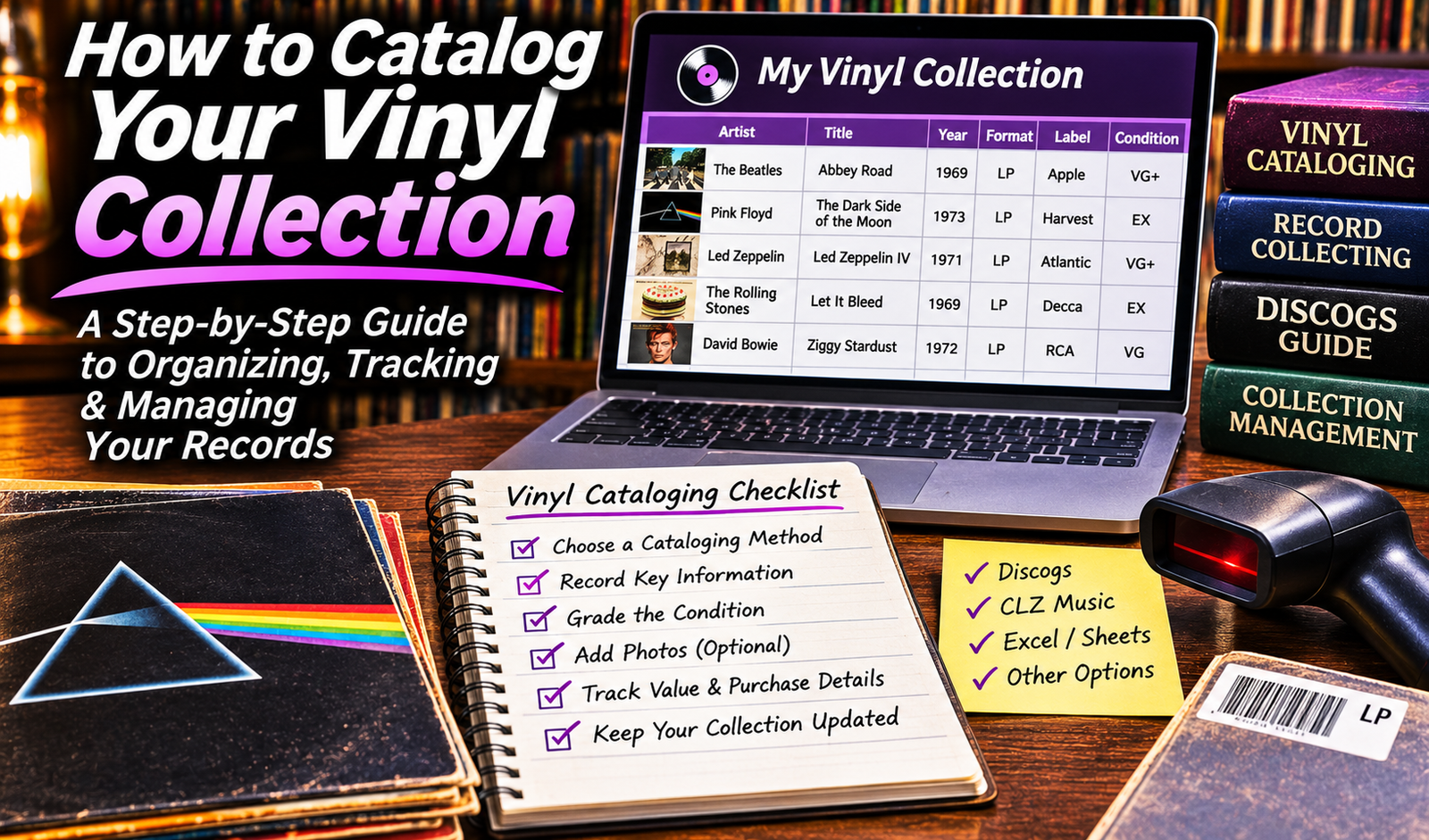
Every vinyl collection starts with a few records. Perhaps you purchase a favorite album, discover an interesting pressing at a thrift store, or inherit a box of records from a family member. Before long, those few albums can grow into hundreds or even thousands of records.
As a collection expands, keeping track of everything becomes increasingly important. Without an organized catalog, collectors may accidentally purchase duplicate albums, forget which pressings they own, or struggle to locate a particular record.
Cataloging your vinyl collection creates a searchable inventory of your records, including artists, titles, pressing information, condition, purchase details, and estimated values.
Whether you own 25 records or 2,500, this guide will show you how to build a practical catalog that grows alongside your collection.
Why Should You Catalog Your Vinyl Records?
A vinyl catalog is more than a list of album titles. It serves as a personal reference system that helps you manage, organize, protect, and understand your collection.
Benefits of Cataloging Your Collection
- Know exactly which albums and singles you own.
- Avoid accidentally purchasing duplicate records.
- Identify different pressings of the same album.
- Track vinyl and sleeve condition separately.
- Record purchase prices and acquisition dates.
- Monitor estimated market values.
- Locate individual records quickly.
- Document rare or unusual editions.
- Maintain an inventory for insurance or estate planning.
- Keep a record of albums you want to purchase.
A well-maintained catalog becomes especially valuable when you begin collecting multiple pressings, promotional copies, international releases, or limited editions.
1. Choose a Vinyl Cataloging Method
Before cataloging your records, decide how you want to store and manage the information.
There are several practical approaches, each with advantages depending on the size of your collection and how much information you want to track.
Spreadsheet Cataloging
A spreadsheet created with Microsoft Excel or Google Sheets is one of the most flexible ways to catalog records.
You can create your own columns, sort records by artist or genre, track purchases, and maintain information without depending entirely on a specialized cataloging service.
Spreadsheets are particularly useful for collectors who want detailed control over their inventory.
Discogs Collection Management
Discogs is a widely used music-release database and marketplace. Its collection features allow users to add documented releases to a personal inventory.
One advantage is the ability to match your record to an existing release entry rather than entering every detail manually.
However, you still need to verify that you are selecting the correct pressing. An album may have dozens or hundreds of documented versions.
Dedicated Music Cataloging Software
Programs such as CLZ Music and other collection-management applications provide additional ways to organize physical music collections.
Depending on the software, features may include barcode scanning, photographs, custom fields, collection statistics, and synchronization across devices.
Compare current features, pricing, and export capabilities before committing to a particular service.
Paper Catalogs
A handwritten notebook or card catalog can work for smaller collections. However, paper records become more difficult to search, reorganize, and back up as the collection grows.
For most collectors, a digital catalog offers greater flexibility and convenience.
2. Decide What Information to Record
The most useful vinyl catalogs record enough information to identify each individual release accurately.
At a minimum, consider including the following fields.
| Catalog Field | Purpose |
|---|---|
| Artist | Identifies the performer or group |
| Album or Song Title | Identifies the recording |
| Record Label | Identifies the issuing label |
| Catalog Number | Helps distinguish releases |
| Release Year | Documents the edition’s release date |
| Country | Identifies the release market |
| Format | LP, single, EP, or other format |
| Vinyl Condition | Records the disc’s grade |
| Sleeve Condition | Records the jacket’s grade |
| Purchase Price | Tracks acquisition cost |
| Storage Location | Helps find the physical record |
| Notes | Documents special characteristics |
You can add optional fields such as matrix numbers, barcode, pressing plant, purchase date, estimated value, signed inserts, and links to release database entries.
3. Identify the Exact Pressing
One of the biggest cataloging mistakes is recording only the artist and album title.
Two copies of the same album may look nearly identical while representing different editions, countries, mastering variations, or manufacturing periods.
These distinctions can affect both collector interest and market value.
Check the Center Label
Examine the label design, catalog number, copyright information, and any unusual markings.
Our Understanding Vinyl Record Labels guide explains how label variations help distinguish different editions.
Examine Matrix and Runout Numbers
The runout area near the center label often contains stamped or handwritten markings. These may help identify mastering information, lacquer cuts, and pressing variations.
Record the inscriptions exactly as they appear, including letters, numbers, and symbols when practical.
See our Vinyl Matrix Numbers Guide for additional information.
Compare Documented Releases
Compare the label, catalog number, runout markings, country, sleeve, and track listing with documented editions.
If the evidence does not establish a precise pressing, mark the edition as unconfirmed rather than guessing.
4. Grade the Record and Sleeve Separately
A record’s physical condition is one of the most important details in a collection catalog.
Always evaluate the vinyl and its sleeve independently. A record may be in excellent playing condition while its jacket has significant wear.
Common Vinyl Grading Terms
- Mint (M): Perfect condition, used very conservatively.
- Near Mint (NM): Very close to perfect with minimal signs of handling.
- Very Good Plus (VG+): Minor wear that generally does not significantly affect enjoyment.
- Very Good (VG): Noticeable wear and potentially audible surface noise.
- Good (G) / Good Plus (G+): Significant wear, although the record may still play through.
- Poor (P) / Fair (F): Severe condition problems that can interfere with playback.
For a complete explanation, read our Vinyl Record Grading Guide.
If you have not listened to a record, note that the grade is based on visual inspection rather than claiming it has been play-tested.
5. Organize Your Physical Collection
A digital catalog becomes much more useful when it corresponds to the way your records are physically stored.
Choose a consistent organizational system and use it throughout your collection.
Alphabetical by Artist
Alphabetical organization is one of the simplest approaches. Records are arranged by the artist or group name, with individual albums grouped together.
By Music Genre
Some collectors prefer separate sections for rock, jazz, blues, classical, country, soul, and other genres.
Within each genre, albums can be arranged alphabetically by artist.
By Format
Collectors with extensive inventories may separate 12-inch LPs, 7-inch singles, 10-inch records, and traditional 78 RPM discs.
Different sizes and materials often benefit from appropriately sized storage solutions.
Assign Storage Locations
For larger collections, identify shelves, cabinets, or storage boxes with simple codes such as A1, A2, B1, and B2.
Include the location code in your catalog so you can find a record without searching through multiple shelves.
For safe storage practices, visit How to Store Vinyl Records.
6. Track Purchase Prices and Estimated Values
Recording what you paid for each record provides a useful history of your collecting activity.
You may also want to record where and when the record was purchased.
For example, your catalog might contain:
- Purchase date
- Purchase price
- Seller or store
- Estimated current value
- Date the value was last researched
- Source of comparable sales information
Keep purchase cost and estimated market value in separate fields. The amount you originally paid may differ significantly from what a comparable copy sells for today.
Market values change, and estimates should reflect the exact pressing and its condition rather than simply the album title.
Our How Much Are My Old Vinyl Records Worth? guide explains the factors that influence record prices.
7. Photograph Important Records
Photographs can make your catalog more useful, particularly when documenting rare pressings or unusual editions.
Consider photographing:
- Front and back album covers
- Both center labels
- Matrix and runout markings
- Promotional stamps or stickers
- Limited-edition numbering
- Autographs and special inserts
- Unusual pressing characteristics
- Existing damage or condition issues
Store photographs using filenames or folder structures that correspond to your catalog entries.
For example, a unique inventory number such as VIN-000125 can identify both the catalog entry and its associated photographs.
8. Use Barcodes Carefully
Barcode scanning can make cataloging faster, especially for more recent releases.
However, a barcode does not always identify a unique pressing. Different editions may share the same barcode, and older records may have no barcode at all.
Use barcodes as a starting point, then confirm the catalog number, label design, and runout information before selecting the exact release.
9. Keep a Separate Vinyl Wantlist
A wantlist is a separate inventory of records you hope to purchase in the future.
It can include artist, title, desired pressing, preferred condition, and your maximum purchase price.
Keeping your wantlist separate from records you already own helps prevent confusion and makes shopping more efficient.
10. Back Up Your Vinyl Catalog
A collection inventory may represent years of research and record collecting. Losing that information can be frustrating and time-consuming.
Maintain backups of your catalog and associated photographs.
- Keep a copy on your primary computer.
- Store another copy on an external drive or other separate device.
- Consider a reputable cloud storage service.
- Export your catalog periodically from online services.
- Use common formats such as CSV when available.
- Check that backup files can actually be opened.
A portable export can also make it easier to change cataloging software in the future.
11. Cataloging a Large Vinyl Collection
If you already own hundreds or thousands of records, cataloging everything at once may seem overwhelming.
The easiest approach is to work in manageable sections.
- Choose one shelf, box, or group of records.
- Enter the basic artist and title information.
- Identify the label and catalog number.
- Confirm the pressing where possible.
- Record the vinyl and sleeve condition.
- Add purchase information if known.
- Assign the physical storage location.
- Move to the next section.
You can return later to add detailed runout information, photographs, and market value estimates.
Consistency matters more than completing every field immediately.
12. Cataloging Rare and Unusual Records
Rare pressings deserve additional documentation because seemingly minor details can affect identification and collector demand.
For valuable or unusual records, consider recording:
- Complete matrix and runout inscriptions
- Pressing plant information when verifiable
- Original inserts and promotional materials
- Distinctive label variations
- Special mastering or pressing details
- Edition numbers or limited-release information
- Provenance or ownership history when documented
- Photographs of identifying features
Our How to Identify Rare Vinyl Records and How to Identify Promotional Vinyl Records guides offer additional identification advice.
13. Using Your Catalog for Insurance and Estate Planning
A detailed catalog can help document a collection for insurance discussions, inheritance planning, or eventual sale.
For particularly valuable collections, photographs, purchase records, and documented valuations can provide useful supporting evidence.
Keep in mind that an online estimate is not necessarily a professional appraisal. Insurance coverage requirements vary, and some insurers may require formal valuations or special coverage for valuable collections.
A clear inventory can also help family members identify the records and understand their potential significance if the collection is inherited.
14. Common Vinyl Cataloging Mistakes
- Recording only album titles. Different pressings may have different values.
- Ignoring matrix numbers. Runout details can help identify specific editions.
- Combining vinyl and sleeve grades. Each should be evaluated separately.
- Relying entirely on barcodes. Multiple editions can share a barcode.
- Confusing asking prices with sold prices. A listing price does not establish market value.
- Failing to update the inventory. New purchases and sales should be recorded.
- Not recording storage locations. A catalog should help you find your records.
- Neglecting backups. Digital records can be lost or become inaccessible.
- Guessing at pressing information. Mark uncertain identifications as unconfirmed.
Vinyl Collection Cataloging Checklist
- Choose a cataloging method.
- Assign a unique inventory number to each record.
- Enter the artist and title.
- Record the label and catalog number.
- Identify the release year and country.
- Check the format and playback speed.
- Document matrix and runout numbers when useful.
- Grade the vinyl and sleeve separately.
- Record purchase price and date.
- Add estimated value and valuation date.
- Photograph important records.
- Record the physical storage location.
- Maintain a separate wantlist.
- Back up the catalog regularly.
- Update the inventory after purchases or sales.
Frequently Asked Questions
What is the easiest way to catalog vinyl records?
For beginners, a simple spreadsheet or collection-management app is often the easiest starting point. Record the artist, album title, catalog number, format, condition, and storage location, then add more details as needed.
Is Discogs good for cataloging vinyl collections?
Discogs is a useful option because its database contains many documented record editions. However, collectors should verify pressing details before adding a particular release to their inventory.
Should I catalog every record individually?
Yes. Separate entries are especially useful when you own multiple copies of the same album with different pressings, grades, or purchase histories.
Can I use Excel to organize my vinyl records?
Absolutely. Excel and Google Sheets allow you to create custom columns, sort and filter your inventory, track purchases, and maintain estimated values.
Do I need to record matrix numbers?
Matrix numbers are not essential for a basic inventory, but they are highly useful when identifying specific pressings, particularly collectible or valuable editions.
How often should I update my vinyl catalog?
Update your catalog whenever you buy, sell, trade, or relocate records. Review estimated market values periodically, especially for higher-value items.
Can a vinyl catalog help with insurance?
Yes. An inventory with photographs, pressing details, purchase records, and documented values can support insurance discussions. Check with your insurer about any appraisal or coverage requirements.
What if I cannot identify the exact pressing?
Record the information you can verify and mark the pressing as unconfirmed. You can update the entry later when additional evidence becomes available.
Final Thoughts
Cataloging your vinyl collection is one of the most useful habits you can develop as a record collector.
A good inventory helps you understand what you own, identify valuable pressings, monitor condition, and keep your collection organized as it grows.
You do not need an elaborate system to begin. Start with the basic information, develop a consistent process, and gradually add more details as you learn about your records.
Continue exploring our Vinyl Record Identification Guide, Vinyl Record Grading Guide, and other Collector Guides.
Want to Track What Your Vinyl Records Are Worth?
Cataloging your records is the first step. Researching their market values can help you understand the collection you’ve built.
At KlassicVinyl.com, you can quickly compare Discogs record values by condition alongside comparable eBay listings. New registered members receive 2 free record searches.