Common Vinyl Manufacturing Defects
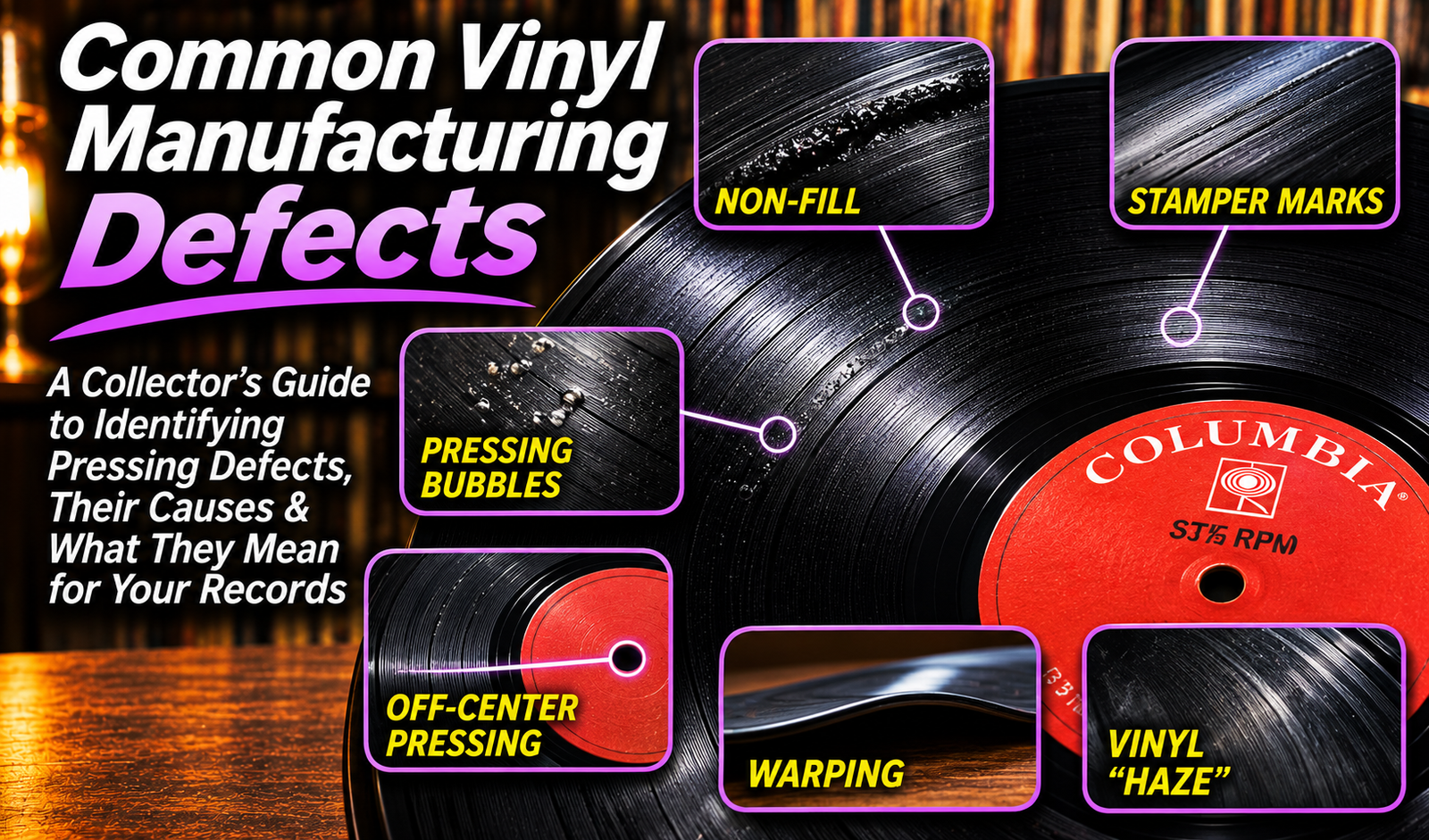
You purchase a brand-new vinyl record, carefully remove it from its sleeve, and place it on your turntable. Instead of the clean playback you expected, you hear crackling, distortion, or an unexpected clicking sound. Perhaps the record appears warped, or the tonearm moves from side to side as the disc rotates.
These problems may be signs of vinyl manufacturing defects. Although modern pressing technology has improved considerably since the earliest days of record production, manufacturing imperfections can still occur.
Understanding these defects helps collectors evaluate record condition, distinguish manufacturing problems from ordinary wear, and decide whether a record should be kept, returned, or replaced.
What Is a Vinyl Manufacturing Defect?
A vinyl manufacturing defect is an imperfection introduced during the mastering, plating, pressing, trimming, or packaging stages of record production.
Some defects affect the grooves and produce audible problems. Others are cosmetic and may have little or no effect on playback.
Common manufacturing defects include:
- Non-fill and incomplete groove formation
- Stitching and separation marks
- Off-center pressings
- Warping and dish-shaped records
- Pressing bubbles and embedded particles
- Stamper damage and repeated groove defects
- Surface haze and cosmetic irregularities
- Edge trimming and label placement problems
Not every visible imperfection is serious. The most important questions are whether the defect affects playback, whether it is permanent, and whether it changes the record’s desirability or value.
How Vinyl Records Are Manufactured
To understand manufacturing defects, it helps to know how records are made.
A recording is first mastered and cut into a lacquer disc or prepared using another suitable mastering process. Metal parts are then manufactured to create stampers containing the groove pattern.
During pressing, heated vinyl material is placed between two stampers. Heat and pressure force the material into the groove pattern. The record is cooled, removed from the press, trimmed, inspected, and packaged.
Problems can develop at several stages. Incomplete vinyl flow may cause non-fill, improper centering can produce pitch instability, and uneven cooling can contribute to warping.
Collector Tip: A manufacturing defect can be present on a completely new record. Being sealed or unplayed does not guarantee that a pressing is free from defects.
1. Non-Fill: Incomplete Vinyl Grooves
Non-fill is one of the better-known vinyl pressing defects. It occurs when heated vinyl does not completely fill the microscopic groove pattern in the stamper.
The resulting groove walls may contain small irregularities or missing detail.
How to Recognize Non-Fill
- Dull or silvery-looking patches across the grooves
- Small areas with a rough or incomplete appearance
- Short bursts of crackling or tearing-like distortion
- Noise that occurs at the same location during repeated playback
- Distortion that remains after appropriate cleaning
Non-fill may sound like a brief ripping or zipper-like noise, although some visually detectable examples are not audible.
Can non-fill be repaired? No. Cleaning cannot restore groove information that was never properly formed. If audible non-fill is significant on a new record, requesting a replacement is generally preferable to attempting a repair.
2. Stitching and Separation Marks
Stitching is a term used for certain small, reflective irregularities that can develop during the pressing and separation process.
These may appear as tiny silvery dots, short streaks, or clustered markings that follow part of the groove pattern.
Collectors sometimes use the terms stitching and non-fill interchangeably, although pressing plants may distinguish between the two.
What Stitching May Sound Like
- Brief crackling sounds
- Raspy or tearing-like distortion
- Repeated noise during a particular passage
- Intermittent surface noise
Some stitching is cosmetic and does not noticeably affect playback. Audible stitching, however, can be a legitimate reason to question the quality of a pressing.
3. Off-Center Vinyl Pressings
An off-center pressing occurs when the groove spiral is not properly centered around the spindle hole.
As the record rotates, the stylus must move slightly from side to side to follow the grooves.
This movement can create a slow, repeating variation in pitch known as wow.
How to Identify an Off-Center Pressing
- Place the record on a properly functioning turntable.
- Observe the tonearm while the record rotates.
- Look for a repeating side-to-side movement.
- Listen for pitch changes on sustained musical notes.
- Compare with another copy when possible.
Piano, organ, strings, and sustained vocals can make off-center pitch variation particularly noticeable.
A center label that appears slightly off-center is not necessarily evidence of an off-center groove. The relationship between the grooves and spindle hole is what matters.
Avoid modifying or enlarging the spindle hole on a collectible record. Such changes are permanent and can reduce its value.
4. Warped Vinyl Records
Warping occurs when a record is no longer reasonably flat. It can originate during manufacturing, cooling, packaging, shipping, or later storage.
A slight warp may be visually noticeable without causing audible problems. More severe warping can interfere with tracking and playback.
Common Types of Warping
- Edge warp: Part of the outer edge rises or falls as the record rotates.
- Dish warp: The record has a shallow bowl-like shape.
- Ripple warp: Several waves or uneven areas appear across the disc.
- Severe localized warp: A pronounced deformation affects a smaller section of the record.
When Is a Warp a Serious Problem?
A warp becomes especially concerning when it causes the stylus to mistrack, produces audible pitch instability, or makes the tonearm bounce significantly.
Never attempt to flatten a valuable record using an oven, direct sunlight, hair dryer, or other improvised heating method. Excessive or uneven heat can permanently damage the grooves.
For additional prevention advice, see our How to Store Vinyl Records guide.
5. Pressing Bubbles and Embedded Contamination
Small bubbles, raised spots, or embedded particles can sometimes appear on a record’s surface.
These may result from trapped gases, foreign material in the vinyl compound, or other manufacturing irregularities.
Some are merely cosmetic. Others may create repeated clicks, pops, or tracking difficulties when they intersect the playing grooves.
Signs of Possible Embedded Defects
- Raised dots or bumps on the record surface
- Visible particles beneath the surface
- Persistent clicks at the same location
- Small irregular patches that cannot be cleaned away
- Unusual noise associated with a visible imperfection
Do not scrape, pick, or cut away raised material. This can damage the grooves and make the problem worse.
6. Stamper Marks and Stamper Damage
A stamper is the metal component used to form the groove pattern during pressing. If a stamper becomes scratched, worn, or contaminated, it can transfer imperfections to the records produced from it.
Stamper-related defects can be especially interesting because multiple copies from the same production run may exhibit similar markings or playback problems.
Possible Signs of Stamper Problems
- Identical marks on multiple copies of a pressing
- Repeated ticks or pops at the same musical passage
- Unusual surface impressions
- Groove irregularities associated with stamper wear
- Distortion shared by multiple copies from the same manufacturing batch
A visible mark alone does not establish stamper damage. Confirmation may require comparing multiple copies or consulting documented pressing information.
7. Vinyl Surface Haze and Cloudiness
Some records display cloudy patches, milky-looking areas, or an uneven surface sheen.
Surface haze can have several causes, including manufacturing-related residue, material variation, contact with certain inner sleeves, or chemical exposure after manufacture.
It is therefore important not to assume every hazy record has a factory defect.
Some haze is purely visual, while other forms may be associated with persistent surface noise or contamination.
If cleaning is appropriate for the record’s material, use a tested record-safe method rather than harsh household chemicals.
See our How to Clean Vinyl Records Safely guide for proper cleaning practices.
8. Edge Defects and Poor Trimming
After pressing, excess vinyl around the outer edge is trimmed away. If this process is imperfect, the record may have rough edges, excess material, or an uneven outer profile.
Minor edge irregularities may have no effect on playback. More serious defects can interfere with handling or the stylus entering the lead-in groove.
Never attempt to trim a record with a knife or other household tool. This can create sharp edges or damage the playing surface.
9. Center Label Manufacturing Problems
Record labels are usually applied during the pressing process. Errors can occur in printing, positioning, or application.
Common Label Problems
- Labels positioned off-center
- Wrinkled or bubbled paper labels
- Incorrect side labels
- Printing errors or missing information
- Labels overlapping the runout area
- Incorrect catalog or track information
Most label problems are cosmetic, but severe misplacement may interfere with playback near the end of a side.
Occasionally, unusual label errors attract specialist collectors. However, an error does not automatically make a record valuable.
Learn more about identifying different label variations in our Understanding Vinyl Record Labels guide.
10. Repeating Clicks, Pops, and Locked Grooves
Repeated playback problems can sometimes be traced to manufacturing defects, but not every click or skip originates at the factory.
Dust, scratches, damaged grooves, and improperly adjusted playback equipment can create similar symptoms.
A locked groove occurs when the stylus remains in a repeating loop rather than advancing through the recording. This may result from a groove defect, damage, or an intentional feature on certain records.
Before concluding that a record is defective, check that the turntable is level, the stylus is clean, and the tracking force is correctly adjusted.
If a new record repeatedly skips at the same location on a properly adjusted system, consider requesting a replacement.
11. Manufacturing Defects vs. Damage After Purchase
One of the most important skills for collectors is distinguishing factory defects from damage that occurred later.
| Problem | Possible Origin | What to Check |
|---|---|---|
| Non-fill | Manufacturing | Incomplete grooves and persistent distortion |
| Off-center grooves | Manufacturing | Side-to-side tonearm movement |
| Warping | Manufacturing, shipping, or storage | Record flatness and playback stability |
| Scratches | Handling or manufacturing | Mark location, appearance, and history |
| Surface haze | Manufacturing, sleeves, or chemical exposure | Surface appearance and cleaning history |
| Crackling | Dirt, wear, or pressing defect | Cleaning and repeatable playback behavior |
Visual inspection and careful listening are usually more informative than appearance alone.
12. Can Manufacturing Defects Be Fixed?
Some playback problems can be improved, but genuine groove manufacturing defects generally cannot be repaired at home.
- Non-fill: Cannot be repaired through cleaning.
- Stitching: Permanent when caused by malformed grooves.
- Off-center grooves: Not safely correctable through ordinary home maintenance.
- Warping: Professional flattening may help some records but carries risks.
- Embedded contamination: May be permanent if trapped in the vinyl.
- Loose surface dirt: Often removable through appropriate cleaning.
For newly purchased records, an exchange is often the most practical solution when a significant manufacturing defect affects playback.
13. Do Manufacturing Defects Affect Record Value?
Yes. Manufacturing defects can reduce a record’s desirability, particularly when they cause audible distortion, skipping, or pitch instability.
A rare pressing may still be collectible despite a defect, but buyers generally expect accurate disclosure of playback problems.
Some unusual manufacturing errors can attract specialist interest. Examples may include striking label misprints or unusual production variations. However, these exceptions should not be confused with ordinary defects that reduce playback quality.
When evaluating a record, consider the exact pressing, condition, documented rarity, and recent comparable sales.
Our Vinyl Record Grading Guide and How Much Are My Old Vinyl Records Worth? guide explain these factors in more detail.
14. How to Inspect a New Vinyl Record
Inspecting a new record before placing it into your collection can help identify problems while a retailer’s return period is still open.
- Examine the surface. Look for scratches, non-fill, unusual marks, and embedded particles.
- Check for warping. Observe whether the disc sits reasonably flat.
- Inspect the labels. Look for printing or placement problems.
- Check the outer edge. Watch for rough trimming or unusual defects.
- Clean when appropriate. Remove loose dust using suitable record-cleaning methods.
- Play the record. Listen for repeating noise, skips, or distortion.
- Observe the tonearm. Look for unusual side-to-side or vertical movement.
- Document any problems. Record the affected side and track, and photograph visible defects.
If a defect affects playback, contact the retailer before attempting modifications that could make the record ineligible for return.
15. Common Mistakes When Evaluating Pressing Defects
- Assuming every pop is a pressing defect. Dirt and static can cause similar sounds.
- Confusing surface scuffs with non-fill. The defects have different causes and appearances.
- Assuming all warps originate at the factory. Heat exposure during shipping or storage can also cause them.
- Ignoring turntable setup. Incorrect tracking force or cartridge alignment can create distortion.
- Attempting unsafe repairs. Heating, scraping, or cutting a record can cause permanent damage.
- Assuming a sealed record is flawless. Manufacturing defects may exist before the package is opened.
- Assuming unusual defects increase value. Most audible defects reduce desirability.
Vinyl Manufacturing Defects Checklist
- Inspect the grooves under good lighting.
- Look for dull patches that may indicate non-fill.
- Check for silvery stitching or separation marks.
- Observe the record for warping.
- Check whether the tonearm moves side to side.
- Look for embedded particles and raised bubbles.
- Inspect the center labels and outer edge.
- Listen for repeating clicks or distortion.
- Confirm the turntable is properly adjusted.
- Distinguish dirt and scratches from factory defects.
- Document significant playback problems.
- Check return options before attempting repairs.
Frequently Asked Questions
Can a brand-new vinyl record have manufacturing defects?
Yes. New records can contain non-fill, off-center grooves, warping, contamination, or other defects introduced during production.
What does non-fill sound like?
Audible non-fill often produces a brief tearing, zipper-like, or crackling sound. It may repeat at the same location during playback.
Is a slightly warped vinyl record defective?
A slight warp may have no audible effect. More severe warping that causes skipping, pitch instability, or tracking problems is more concerning.
Can cleaning fix a pressing defect?
Cleaning can remove surface contamination, but it cannot restore missing or malformed groove information caused by non-fill or other permanent pressing defects.
Why does my record sound distorted even though it looks clean?
Possible causes include pressing defects, groove wear, mastering characteristics, cartridge alignment, or stylus problems. A visual inspection alone may not identify the cause.
What is an off-center pressing?
An off-center pressing has grooves that are not correctly centered around the spindle hole. This can cause the tonearm to move sideways and the music’s pitch to waver.
Do pressing defects make vinyl records rare?
Not necessarily. Some unusual manufacturing errors attract collectors, but most defects that impair playback reduce a record’s desirability.
Should I return a new record with a pressing defect?
If a significant defect causes audible distortion, skipping, or other playback problems, contact the retailer about a replacement or return. Minor cosmetic imperfections may not justify an exchange, depending on the circumstances and retailer policy.
Final Thoughts
Vinyl manufacturing defects are an important part of record collecting because even carefully produced records can contain imperfections.
Learning to recognize non-fill, stitching, off-center grooves, warping, and other pressing flaws can help you make better purchasing decisions and evaluate the true condition of your records.
Remember that not every visual irregularity affects playback. A careful combination of visual inspection, proper cleaning, and listening provides the best basis for evaluating a questionable record.
Continue learning with our Vinyl Record Grading Guide, How to Clean Vinyl Records Safely, and other Collector Guides.
Wondering What Your Vinyl Records Are Worth?
Understanding record condition and pressing quality is an important step toward researching market value.
At KlassicVinyl.com, you can quickly compare Discogs record values by condition alongside comparable eBay listings. New registered members receive 2 free record searches.