Understanding Vinyl Record Labels
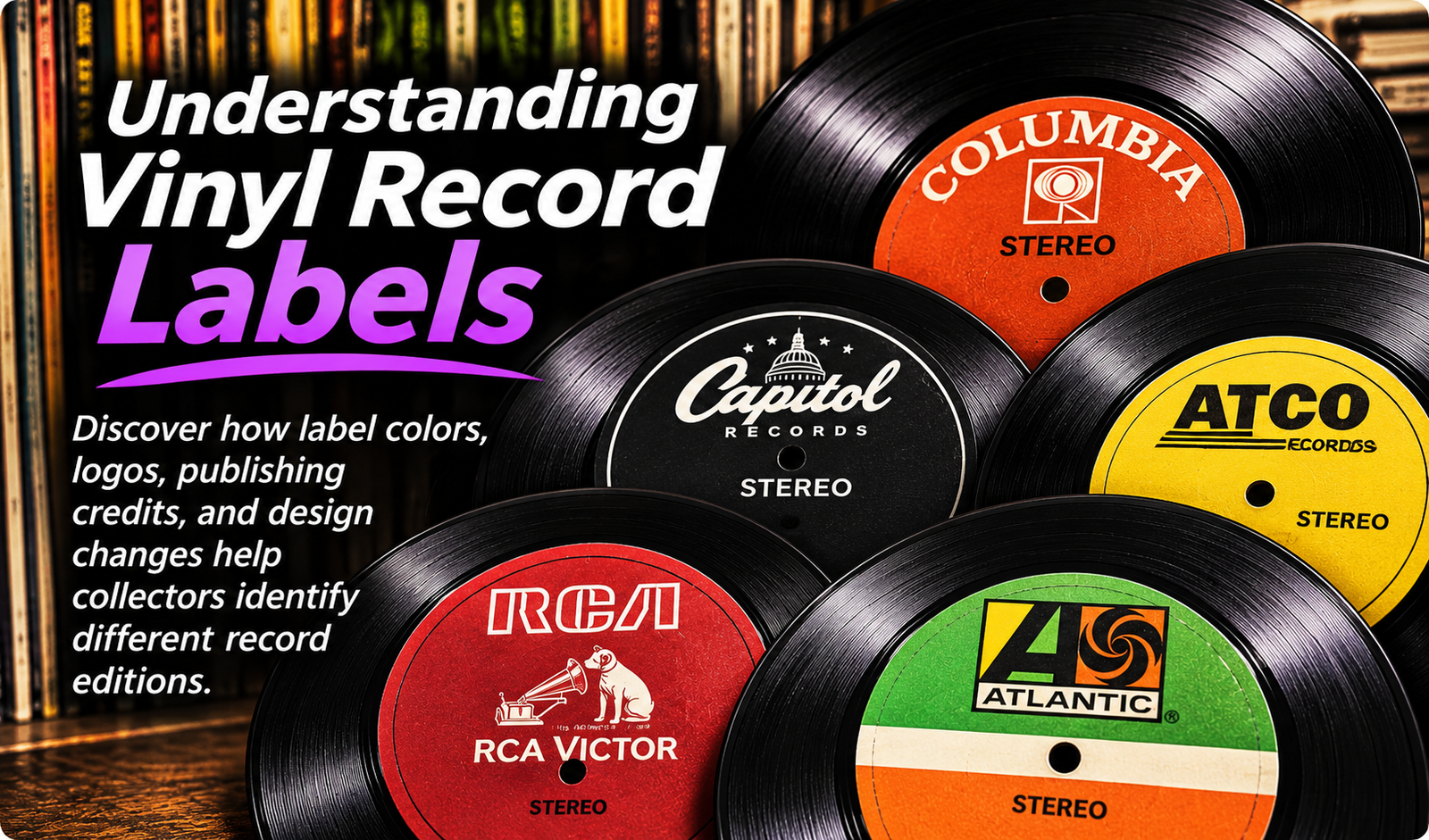
Every vinyl record tells a story, and some of its most useful clues are printed directly on the label surrounding the spindle hole. The colors, logos, typography, catalog numbers, publishing credits, and manufacturing details can help collectors distinguish one edition from another.
For collectors researching original pressings, early releases, and potentially valuable records, understanding these label details is an essential skill. However, a label should never be evaluated in isolation. Identifying an exact pressing usually requires comparing the label with the record’s runout markings, sleeve, and other manufacturing information.
Why Vinyl Record Labels Matter
Record companies have changed their label designs repeatedly over the decades. A familiar album may exist with several different label variations, sometimes reflecting different manufacturing periods, countries, pressing plants, or reissue programs.
Two copies of the same album may have identical artwork and track listings but different center labels. These differences can provide valuable clues about when and where each copy was manufactured.
Collectors study labels to help determine:
- Whether a record is an early pressing or later reissue
- Which country or market a record was manufactured for
- Whether a label design matches a documented release period
- Whether the record belongs to a particular pressing variation
- Whether the label agrees with the sleeve and runout information
- Which exact edition should be used for a value comparison
1. Understanding Record Label Colors
Color is often the first feature collectors notice. Record companies sometimes used different colors for different series, formats, musical genres, or manufacturing periods.
For example, a record label might use a particular color scheme during one period and adopt a completely different design years later. Identifying the appropriate label variation can help narrow down the possible release dates.
However, label color alone is not reliable proof of an original pressing. Companies frequently reused older designs, produced different variations simultaneously, and issued records in multiple countries with different label styles.
Collector Tip: Always compare a label’s color with documented examples for the specific artist, album, catalog number, and country. A color associated with early releases from one company may not have the same significance for another.
2. Record Company Logos and Their Evolution
Record company logos can provide important historical clues. Major labels such as Columbia, Capitol, RCA Victor, Atlantic, and others have changed their logos and label layouts over time.
Some changes involved redesigned lettering, altered symbols, different placement of the company name, or revised background graphics. Others reflected changes in corporate ownership or distribution arrangements.
When researching a record, look closely at the exact logo variation rather than simply identifying the record company.
Examples of Useful Logo Details
- Changes in the size or shape of a company symbol
- Different lettering styles or fonts
- New corporate names or ownership references
- Revised trademarks or legal notices
- Changes in logo placement on the center label
- Different designs used by international affiliates
These details can help identify a likely manufacturing period, but they should be checked against reliable release documentation.
3. Catalog Numbers: One of the Most Important Clues
The catalog number is one of the most useful pieces of information printed on a record label. It is typically assigned by the record company to identify a release within its catalog.
Catalog numbers may contain letters, numbers, prefixes, or suffixes. They often appear on both the center label and the album sleeve.
A catalog number can help identify the general release, but multiple pressings may share the same number. Some companies also changed catalog numbers when issuing stereo editions, budget reissues, or international releases.
What to Compare
- The catalog number printed on the label
- The catalog number on the front or back cover
- Any prefixes or suffixes
- Numbers printed near the center hole
- Numbers and letters etched or stamped into the runout area
Be aware that the smaller number printed near the spindle hole may be a side-specific matrix number rather than the main catalog number.
For a deeper explanation, read our Guide to Vinyl Matrix Numbers.
4. Publishing Credits and Copyright Information
Publishing credits can help distinguish different label variations. These credits identify the music publishers or other rights holders associated with the compositions on the record.
Publishing arrangements can change over time. A later pressing might display a different publisher, revised copyright notice, or updated rights information even when the music itself is unchanged.
Details Worth Examining
- Music publishing company names
- Copyright and phonogram copyright symbols
- Rights society abbreviations such as ASCAP, BMI, or GEMA
- Changes in song credits or songwriting information
- Manufacturing and distribution statements
- Trademark and licensing notices
A copyright year is not necessarily the year your particular copy was pressed. A record manufactured decades later may still display the original recording’s copyright date.
5. Typography and Label Layout Changes
Sometimes the differences between two pressings are surprisingly small. One edition may use bold lettering while another uses a thinner font. The artist’s name may appear above the album title on one pressing and below it on another.
Other differences include spacing, text alignment, track listing placement, and the arrangement of copyright information.
Collectors often refer to these differences as label variants or typesetting variations. They can sometimes help distinguish pressings made by different plants or during different production runs.
A different font does not automatically make a record rare or valuable. Its significance depends on whether that variation is documented and sought after by collectors.
6. Identifying Mono and Stereo Labels
Many records from the period when stereo recordings became widespread were issued in both mono and stereo editions. The labels may include words such as MONO, MONAURAL, or STEREO.
Some record companies used different catalog number prefixes or label designs to distinguish the two formats.
These differences are particularly important when researching albums from the late 1950s and 1960s, when mono and stereo versions sometimes featured substantially different mixes.
Learn more in our Mono vs. Stereo Vinyl Records Guide.
7. Record Labels and Pressing Plant Identification
Record companies often used multiple pressing plants to manufacture the same album. These facilities sometimes produced records with slightly different label typography, spacing, or layout.
Certain plants also used identifying codes or symbols, although their location and meaning vary by company and manufacturing period.
The center label may provide clues, but pressing plant identification is usually more reliable when combined with information found in the runout area.
The runout, sometimes called the dead wax, is the area between the final groove and the center label. It may contain stamped or handwritten information identifying mastering, plating, or pressing details.
8. Can a Record Label Prove a First Pressing?
Not by itself. A label that matches an early design is an encouraging clue, but it does not necessarily prove that a record is a first pressing.
A record company might continue using an older label design after the initial release. Multiple pressing plants might also manufacture the first edition with slightly different labels.
To identify a likely first pressing, compare:
- The label design and typography
- The catalog number and matrix information
- The country of manufacture
- The pressing plant identifiers
- The original sleeve and packaging details
- Documented release variants from reliable databases
See our How to Identify Rare Vinyl Records guide for additional identification methods.
9. Comparing Labels Across Countries
The same album may have been released in the United States, United Kingdom, Germany, Japan, Canada, and many other markets.
International editions can feature different record company logos, label colors, catalog numbers, copyright notices, and manufacturing statements.
An album originally released in one country may have been manufactured under license by a different company elsewhere. This can result in label designs that look completely different even though the recordings are similar or identical.
When identifying a record, always determine its country of manufacture before comparing it with other pressings.
10. Do Different Labels Affect a Record’s Value?
They can. Certain label variations are more collectible because they are associated with scarce editions, desirable early pressings, or historically significant releases.
However, an unusual label is not automatically valuable. The importance of a particular variation depends on collector demand, documented scarcity, condition, and the specific recording.
Condition remains especially important. A desirable pressing with significant groove wear, scratches, or sleeve damage may sell for considerably less than a well-preserved copy.
For more information, visit How Much Are My Old Vinyl Records Worth? and our Vinyl Record Grading Guide.
11. How to Research an Unknown Record Label
If you encounter a record with an unfamiliar label, begin by recording all the information printed on it.
- Identify the record company. Note the name and any logos or symbols.
- Record the catalog number. Include every letter, number, prefix, and suffix.
- Check the country. Look for manufacturing or distribution statements.
- Examine the label design. Record the colors, typography, and layout.
- Read the publishing credits. Note copyright dates and publisher names.
- Inspect the runout area. Carefully record etched or stamped markings.
- Compare documented releases. Use release databases and photographs to narrow down the exact edition.
Photographing both sides of the label and the sleeve can make research easier, especially when comparing several similar pressings.
12. Common Mistakes Collectors Make
- Assuming a familiar label color proves a first pressing. Designs were sometimes reused.
- Treating the copyright year as the pressing date. The two can differ by decades.
- Ignoring the country of manufacture. International editions may have entirely different labels.
- Using only the catalog number. Several editions can share the same number.
- Overlooking the runout markings. These may be essential for distinguishing pressings.
- Assuming every unusual variation is rare. Some differences are common manufacturing variations.
Vinyl Record Label Identification Checklist
Use this checklist whenever you examine a record you want to identify accurately.
- Record company name and logo
- Label background color and design
- Artist and album title typography
- Catalog number and side-specific numbers
- Mono or stereo designation
- Publishing and copyright credits
- Country of manufacture
- Pressing plant information, if identifiable
- Runout matrix numbers and symbols
- Matching sleeve and packaging details
- Comparison with documented release variations
Frequently Asked Questions
How can I tell how old a vinyl record is from its label?
Compare the label design, logo, catalog number, and publishing credits with documented release histories. These details may narrow the likely manufacturing period, but they do not always establish an exact pressing year.
Does a different label color mean a record is rare?
Not necessarily. Some label colors are associated with scarce pressings, while others were widely produced. Rarity must be established for the specific edition.
Can two original pressings have different labels?
Yes. Different pressing plants sometimes produced records during the original release period using different typesetting or label variations.
Where is the catalog number on a vinyl record?
It is commonly printed on the center label and often on the sleeve. Its location and format vary by record company.
What is the difference between a catalog number and a matrix number?
The catalog number generally identifies a commercial release, while matrix numbers identify recording or manufacturing components, such as sides or lacquer cuts. Runout markings can provide more specific pressing information.
Are older record labels always more valuable?
No. Value depends on the specific pressing, condition, scarcity, demand, and comparable sales. Some later editions are collectible, while many early pressings remain inexpensive.
Final Thoughts
Understanding vinyl record labels opens another window into the history of recorded music. Colors, logos, publishing credits, and subtle design changes can reveal useful information about how a record was produced and distributed.
For collectors, the most reliable approach is to combine label identification with catalog numbers, runout markings, sleeve details, and documented release information. The more evidence you gather, the more confidently you can identify the exact edition in your collection.
Continue learning with our Vinyl Record Identification Guide or explore more articles in our Collector Guides collection.
Wondering What Your Vinyl Records Are Worth?
Once you’ve identified your record’s pressing, the next step is researching its market value.
At KlassicVinyl.com, you can quickly compare Discogs record values by condition alongside comparable eBay listings. New registered members receive 2 free record searches.