How to Read Vinyl Matrix Numbers
Two records can have identical covers, song lists, and catalog numbers yet come from entirely different pressings. One of the most useful ways to distinguish them is to examine the small numbers, letters, and symbols found near the center label. These markings are commonly called vinyl matrix numbers.
Learning how to read vinyl matrix numbers can help you investigate a record’s manufacturing history, compare different editions, and identify the exact version you own. The markings are especially useful when album artwork and printed labels do not provide enough information.
What Are Vinyl Matrix Numbers?
Matrix numbers are identifiers associated with the recorded side and the manufacturing process. They often appear in the smooth area between the final groove and the center label, commonly known as the deadwax or runout area.
Some markings are stamped by machinery, while others are handwritten or etched. A single record may contain several separate codes, including a matrix identifier, a lacquer-cut designation, a pressing-plant mark, or the initials of a mastering engineer.
There is no universal format used by every record company. The meaning of a particular code depends on the label, pressing plant, country, and period in which the record was manufactured.
Where to Find the Matrix Number
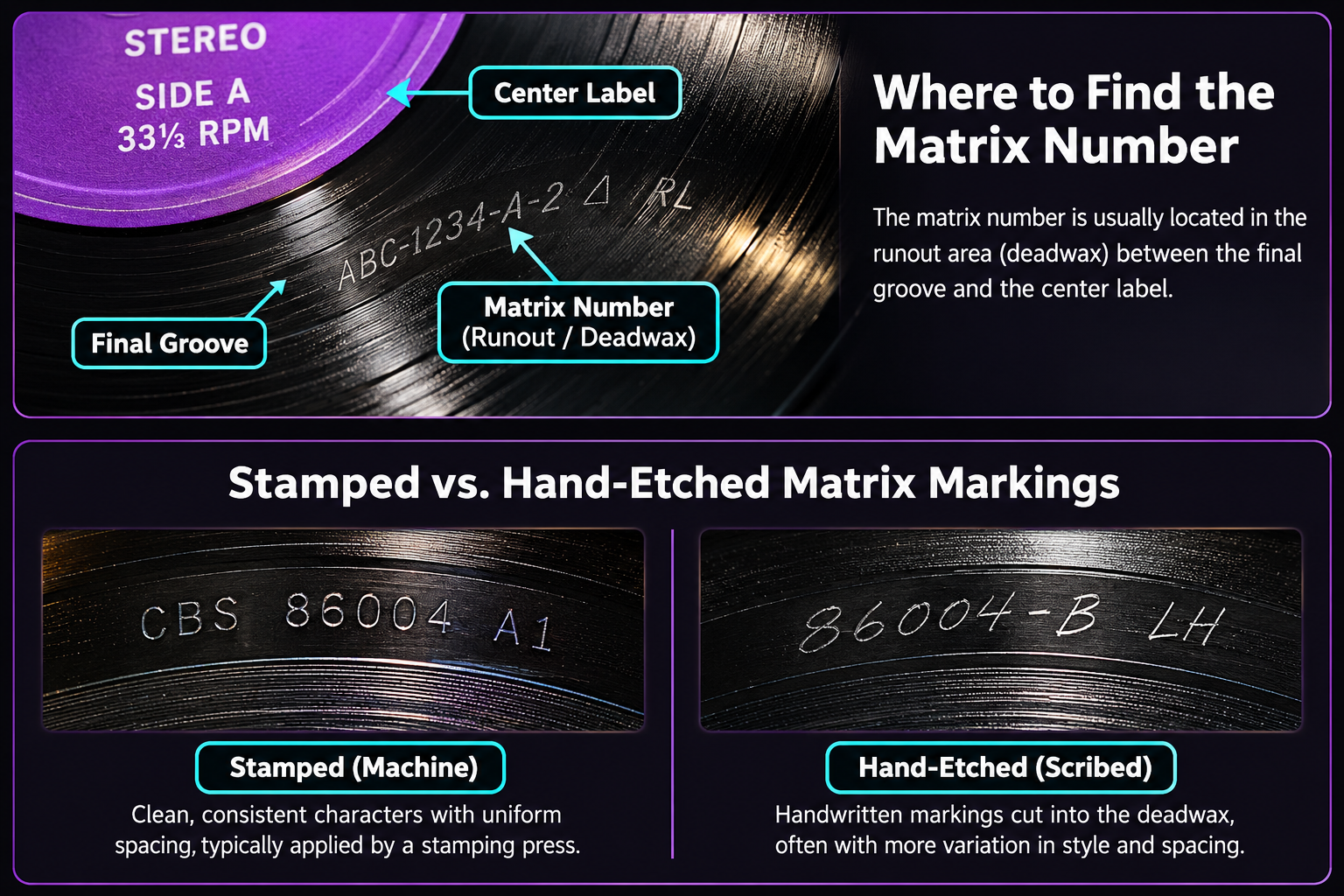
Remove the record from its sleeve and hold it by the edges and center label. Under a bright light, gently tilt the disc until the markings become visible in the runout area. You may need to rotate the record to read all of them.
- Look between the last music groove and the paper center label.
- Check both sides of the record independently.
- Use indirect lighting or a small flashlight to reveal faint etchings.
- Write down every letter, number, space, and symbol as accurately as possible.
- Note which markings are stamped and which appear handwritten.
A magnifying glass can help with particularly faint inscriptions. Avoid touching the playing surface or applying unnecessary pressure while inspecting the record.
How to Interpret Common Matrix Markings
Matrix inscriptions often contain several pieces of information. Their exact meaning varies, but the following patterns are useful starting points.
- Base matrix identifier: Often links the disc to a particular recording side or production master.
- Side designation: Letters or numbers may distinguish Side A from Side B.
- Cut or lacquer designation: A suffix may identify a particular lacquer cut, although numbering systems vary.
- Pressing-plant markings: Symbols, initials, or stamped identifiers can sometimes indicate where the record was manufactured.
- Mastering engineer signatures: Certain engineers left recognizable initials, names, or symbols in the runout area.
This fictional inscription might contain a base identifier (ABC-1234), a side designation (A), and a cut designation (2). However, these meanings cannot be assumed without checking the specific label’s documentation.
Stamped Versus Hand-Etched Numbers
Stamped markings usually have consistent lettering and spacing, while hand-etched markings often look less uniform. Both can be valuable identification clues.
The presence of stamped or handwritten characters does not, by itself, prove that a record is an original pressing. Different mastering facilities and manufacturers used different methods, and some releases contain a mixture of stamped and etched information.
Can Matrix Numbers Identify a First Pressing?
Sometimes, but matrix numbers should never be treated as conclusive evidence on their own. An early-looking matrix suffix may suggest a particular lacquer cut, yet the same metal parts could sometimes be used for multiple production runs.
To investigate whether a record is a first pressing, compare the runout inscriptions with other identifying details, including the label design, catalog number, sleeve construction, country of manufacture, and known release variations.
For a broader explanation, see our guide to identifying vinyl record pressings.
Why Two Copies of the Same Album May Have Different Numbers
Popular albums were often manufactured in multiple plants, countries, or production periods. New lacquer cuts could be prepared when earlier parts wore out or when production requirements changed.
Consequently, two copies with the same printed catalog number might carry different runout inscriptions. These differences can help distinguish manufacturing variants, but they do not automatically establish that one copy is rarer, better sounding, or more valuable.
How to Research Your Matrix Number
Begin by recording the complete inscription from each side. Then compare your record against documented release variations in a reliable discography, such as Discogs. Check the full runout descriptions rather than relying on the album title or catalog number alone.
Also compare photographs of the labels, manufacturing credits, and country information. Some documented entries contain minor transcription differences, so evaluate the complete combination of evidence before deciding which edition matches your copy.
Do Matrix Numbers Affect Vinyl Record Value?
Matrix numbers do not directly determine value. Instead, they help identify the specific pressing or variant, which can then be compared with relevant market listings and past sales.
Collectors may pay more for certain early pressings, unusual manufacturing variants, or editions with distinctive mastering histories. However, demand, authenticity, completeness, and especially record condition remain important.
For additional context, read what makes vinyl records rare and valuable.
Common Mistakes to Avoid
- Assuming a low matrix suffix always means the earliest retail pressing.
- Ignoring the inscriptions on the second side.
- Confusing the printed catalog number with the runout matrix information.
- Assuming every symbol identifies a pressing plant.
- Matching a release using only one number while overlooking label and sleeve differences.
The most reliable approach is to use matrix information as one part of a broader identification process. Accurate identification often depends on several details agreeing with one another.
Identified Your Pressing? Explore Its Value.
Once you have narrowed down the edition you own, KlassicVinyl can help you explore condition-based Discogs pricing and comparable eBay listings to better understand its potential market value.