How to Spot Counterfeit Vinyl Records
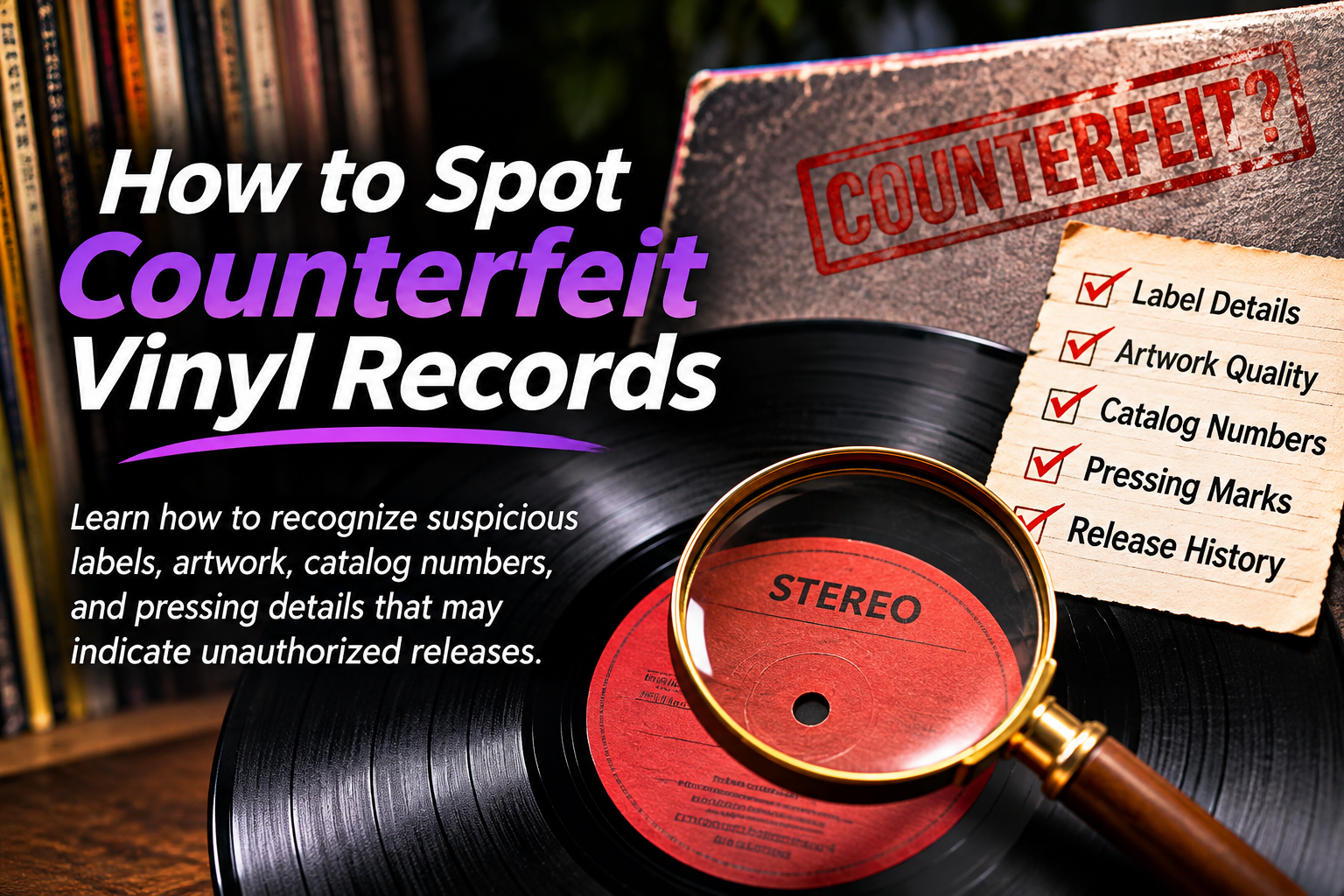
How to Spot Counterfeit Vinyl Records
Counterfeit vinyl records can be difficult to identify, especially when a reproduction closely resembles an original release. Collectors may encounter suspicious copies at record stores, online marketplaces, estate sales, and private collections.
Some counterfeit records imitate valuable first pressings, while other unauthorized releases reproduce albums that are rare, out of print, or otherwise difficult to obtain.
Learning how to examine record labels, cover artwork, catalog numbers, and manufacturing details can help collectors make more informed purchasing decisions and avoid paying original-pressing prices for unauthorized copies.
What Is a Counterfeit Vinyl Record?
A counterfeit vinyl record is generally a reproduction made to imitate a legitimate release, often without authorization from the appropriate rights holders.
Counterfeit copies may reproduce the original album artwork, record labels, catalog numbers, and other identifying details in an effort to appear authentic.
However, not every unofficial record is necessarily a counterfeit. Understanding the distinction between counterfeits, bootlegs, and legitimate reissues is important.
Counterfeit Records
Counterfeit records are designed to imitate an existing release. They may be presented as authentic originals or legitimate reissues even though they were produced without authorization.
Bootleg Records
Bootlegs commonly contain recordings that were not officially released by the artist or record label, such as unauthorized live performances, demos, or studio outtakes.
Although bootlegs are generally unauthorized, they do not always attempt to imitate an existing commercial release.
Official Reissues
Legitimate reissues are authorized releases manufactured after an album’s original publication. They may reproduce original artwork and label designs while including updated manufacturing information.
A reissue is not counterfeit merely because it looks different from an original pressing.
Examine the Album Cover Artwork
Album cover artwork can provide some of the earliest clues that a record may not be an authentic pressing.
Counterfeit manufacturers sometimes reproduce original artwork from photographs, scans, or previously printed sleeves. Depending on the source material and printing process, these reproductions may show visible differences.
Blurry or Low-Resolution Printing
Examine photographs, logos, and small lettering closely. Some reproductions may contain softer images, less distinct details, or visible printing artifacts.
Incorrect Colors
Compare the cover with documented examples of the exact pressing. Differences in color saturation, contrast, or background shades can sometimes indicate a reproduction.
Missing Printing Details
Original sleeves may contain printer credits, manufacturing information, copyright notices, or other small details that are missing or altered on suspicious copies.
Inspect the Record Label Carefully
The center label is one of the most useful areas to examine when identifying a suspicious vinyl record.
Record labels often contain distinctive typography, logos, catalog numbers, publishing information, and manufacturing credits.
Compare these details with verified photographs of the release you believe you own.
Typography and Spacing
Look for differences in font styles, text alignment, letter spacing, and the placement of track information.
Record Label Logos
Some unauthorized reproductions use logos that differ slightly from those found on documented originals.
Copyright and Manufacturing Information
Check for unexpected dates, missing credits, inconsistent country information, or other details that conflict with the claimed edition.
These characteristics are most useful when compared against documented copies rather than judged in isolation.
Check the Catalog Number
A catalog number is an identifier assigned by a record label to a particular release or series of releases.
It commonly appears on the record label, sleeve spine, back cover, or other packaging.
When examining a potentially counterfeit record, compare the catalog number across the packaging and the disc itself.
Consider the following questions:
- Does the catalog number match the claimed release?
- Is the number printed consistently on the sleeve and record label?
- Does the number correspond to a documented pressing?
- Are there known legitimate variations using the same catalog number?
- Does the country or release date agree with the other identifying details?
A matching catalog number is useful, but it does not establish authenticity by itself. Counterfeit records can reproduce legitimate catalog numbers.
Examine the Matrix and Runout Markings
The runout area, also called the deadwax, is the smooth section between the final music groove and the center label.
This area often contains stamped or hand-etched manufacturing information that can help distinguish different pressings.
Runout markings may include matrix numbers, lacquer-cutting identifiers, mastering engineer signatures, pressing plant marks, and other production information.
To examine the runout area:
- Hold the record carefully by its edges and center label.
- Use bright, indirect lighting to inspect the deadwax.
- Rotate the record slowly to identify inscriptions.
- Record every letter, number, and symbol from both sides.
- Compare the complete inscriptions with documented copies of the claimed pressing.
Our Vinyl Matrix Numbers Guide explains how to locate and interpret common runout information.
Why Runout Markings Matter
A counterfeit sleeve may closely imitate an original, but the record itself may have been manufactured using different metal parts or a different production process.
Unexpected runout inscriptions can therefore provide important evidence that a record is not the pressing being advertised.
However, missing or different inscriptions do not automatically prove counterfeiting. Legitimate manufacturing variations may exist.
Look for Pressing Plant Clues
Pressing plants sometimes used distinctive manufacturing marks, symbols, or inscription patterns.
Comparing these details can help determine whether a record’s manufacturing history is consistent with the claimed edition.
Some legitimate pressings also have recognizable center-label pressing rings or other physical characteristics.
For a detailed explanation, read our How to Identify a Vinyl Record Pressing Plant guide.
Watch for Suspicious Packaging Details
Packaging can provide additional clues when examining a potentially unauthorized release.
Examples include:
- Unusual sleeve construction compared with verified copies.
- Missing or altered manufacturing credits.
- Unexpected barcode information.
- Incorrect spine text or catalog numbers.
- Printing inconsistencies across the front and back covers.
- Packaging that conflicts with the claimed release period.
Remember that packaging materials and printing methods have changed over time. A single unusual detail is not enough to establish that a record is counterfeit.
Be Careful With Claims of Rare First Pressings
Rare and valuable first pressings can attract counterfeit reproductions because collectors may pay substantial premiums for authentic examples.
If a seller advertises a record as an original first pressing, verify the claim carefully.
Compare the record’s labels, matrix markings, sleeve details, country of manufacture, and known release history.
Our First Pressing vs. Reissue Guide explains why identifying the exact edition matters.
Research the Release Before Buying
One of the most effective ways to investigate a suspicious record is to compare it with documented examples.
Discogs can be useful for reviewing release variations, catalog numbers, label photographs, and matrix information. However, its entries are community-contributed and may contain incomplete or inaccurate information.
For valuable records, compare multiple sources whenever possible, including reliable discographies, specialist collector references, and photographs of verified copies.
Questions to Ask the Seller
- Can you provide clear photographs of both record labels?
- Can you photograph the matrix markings on both sides?
- Does the sleeve match the exact edition being advertised?
- Is there documentation supporting the claimed pressing?
- What is the seller’s return policy if the edition is misidentified?
A reputable seller should be willing to provide reasonable identifying information, especially for an expensive collectible record.
Does Poor Sound Quality Mean a Record Is Counterfeit?
Not necessarily. Sound quality can vary for many reasons, including mastering choices, pressing quality, groove wear, playback equipment, and record condition.
Some unauthorized records may be produced from inferior audio sources, but poor sound alone does not establish that a record is counterfeit.
Likewise, a good-sounding record is not necessarily an authorized pressing.
Are Counterfeit Records Always Valuable?
No. A counterfeit record generally should not be valued as though it were the authentic pressing it imitates.
Some historical unauthorized releases have developed collector interest of their own, but their market values depend on demand, scarcity, condition, and the specific release.
It is important to identify a record accurately before comparing sales prices.
Our How Much Are My Old Vinyl Records Worth? guide explains the factors that influence collectible value.
Common Mistakes When Identifying Counterfeit Vinyl
- Assuming every unusual pressing is counterfeit.
- Confusing authorized reissues with unauthorized reproductions.
- Relying only on album cover artwork.
- Ignoring matrix and runout information.
- Assuming a matching catalog number guarantees authenticity.
- Accepting first-pressing claims without supporting evidence.
- Using price alone to determine whether a record is genuine.
- Trusting a single undocumented online identification.
A Practical Counterfeit Vinyl Identification Checklist
Before purchasing a potentially valuable record, examine as many of the following details as possible:
- Front and back cover artwork.
- Spine printing and packaging construction.
- Center-label logos and typography.
- Catalog numbers and manufacturing credits.
- Matrix and runout inscriptions from both sides.
- Pressing plant identifiers when documented.
- Country of manufacture and release history.
- Comparison with verified photographs and discographies.
- Seller documentation and return terms.
Frequently Asked Questions About Counterfeit Vinyl Records
Can counterfeit records have the same catalog number as an original?
Yes. Counterfeit copies may reproduce the catalog number of the legitimate release they imitate. Always examine additional identifying details.
Can a counterfeit vinyl record sound good?
Yes. Sound quality alone cannot establish whether a release was authorized or whether it matches the edition being advertised.
Are unofficial colored vinyl records always counterfeit?
No. Colored vinyl has been used for many legitimate releases. The color of a record alone does not determine its authenticity.
Can Discogs help identify counterfeit records?
Discogs may contain entries and notes describing known unofficial or counterfeit releases. However, information should be verified against additional reliable sources when authenticity is uncertain.
What should I do if I suspect a record is counterfeit?
Document the record’s identifying details, compare them with verified releases, and contact the seller if the item was misrepresented. For an expensive purchase, consider consulting a knowledgeable record dealer or specialist.
Final Thoughts on Spotting Counterfeit Vinyl Records
Identifying counterfeit vinyl records requires careful observation and reliable research. Album artwork, record labels, catalog numbers, and runout inscriptions can all provide valuable clues.
The most dependable approach is to compare multiple identifying characteristics with documented examples of the exact release.
Understanding the difference between legitimate reissues, unofficial releases, and counterfeits can help collectors avoid costly mistakes and make more informed purchases.
For additional information, explore our Vinyl Record Identification Guide and How to Identify Rare Vinyl Records guide.
Discover What Your Vinyl Records Are Worth
Once you’ve identified the exact pressing you own,
KlassicVinyl can help you research Discogs
condition-based pricing and comparable eBay listings
to better understand its potential market value.
New members receive 2 free record searches!