First Pressing vs. Reissue: How to Tell the Difference
Two copies of the same album can look almost identical while representing very different editions. One may have been manufactured when the album first appeared, while the other may have been produced years or decades later. Understanding the difference between a first pressing and a reissue is an important part of identifying collectible vinyl records.
For collectors, the challenge is that original pressings, later repressings, and reissues can share artwork, catalog numbers, and even some manufacturing characteristics. No single detail reliably identifies every first pressing.
What Is a First Pressing?
A first pressing generally refers to records manufactured during the earliest production run associated with an album’s initial release in a particular market. However, collectors and discographies do not always use the term consistently.
An album might have been manufactured at several pressing plants simultaneously, and different countries may have released it at different times. Consequently, more than one early variant may legitimately belong to an initial release period.
The term original pressing is sometimes used more broadly to describe an early edition from the original release era, rather than a specifically documented first manufacturing run.
What Is a Repress?
A repress is a subsequent manufacturing run of an existing release, generally retaining the same essential edition characteristics. A repress may use the same artwork, catalog number, and sometimes the same metal parts used for earlier copies.
Because manufacturing components can be reused, the runout markings of an early pressing and a later repress may be very similar or even identical. Other evidence may be necessary to distinguish them.
What Is a Reissue?
A reissue is a later release of an existing recording, often introduced as a new edition. Reissues may feature different catalog numbers, updated label designs, new mastering, revised packaging, bonus material, or a different format.
Some reissues deliberately reproduce the appearance of earlier editions. Modern reproductions may use vintage-style labels and artwork, making careful examination especially important.
First Pressing vs. Reissue: Key Differences
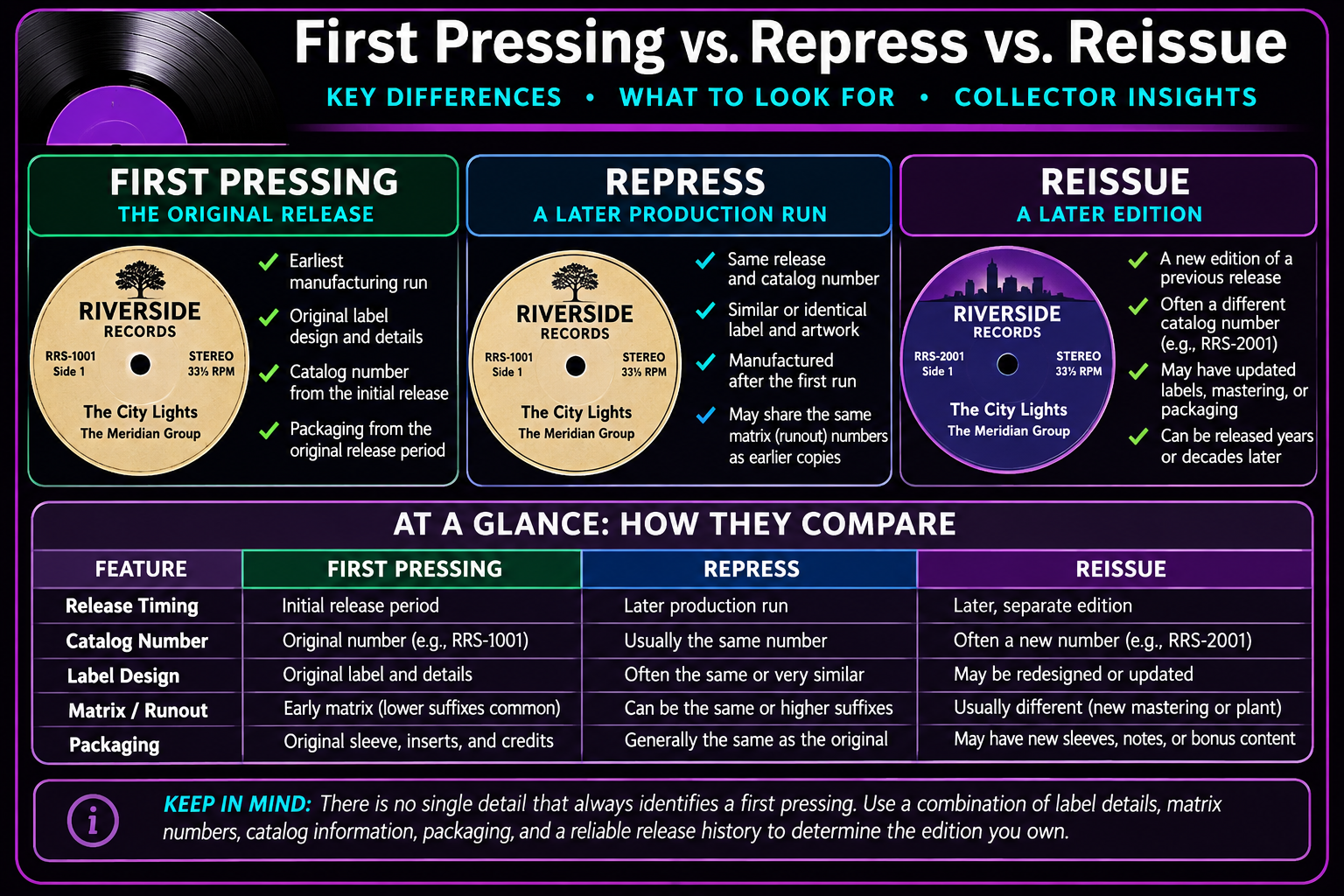
Repress: A subsequent production run that generally continues an existing edition.
Reissue: A later edition of previously released recordings, potentially with new mastering, packaging, or identifiers.
These definitions are useful starting points, but release histories can be complicated. Record companies did not always document manufacturing changes clearly, and terminology may differ between collectors and marketplaces.
1. Examine the Record Label
The center label is often one of the most useful identification clues. Record companies changed label colors, logos, typography, legal notices, and manufacturing information over time.
Compare the label on your copy with documented photographs of known editions. Pay attention to small details, including text placement, copyright wording, country information, and the presence or absence of particular logos.
A label design can help narrow the manufacturing period, but labels alone do not always establish an exact pressing date.
2. Check the Matrix and Runout Numbers
Look in the smooth area between the final groove and the center label. This is the deadwax or runout area, where manufacturers often placed matrix numbers, mastering marks, lacquer identifiers, and pressing-plant symbols.
Early matrix suffixes can sometimes provide useful evidence, but they are not universal proof of a first pressing. Numbering systems vary, and some manufacturing parts were reused in later production runs.
For detailed instructions, read our guide to reading vinyl matrix numbers.
3. Compare Catalog Numbers
The catalog number appears on the center label, sleeve, spine, or other packaging. It can help distinguish releases, especially when a record company assigns a new number to a later edition.
However, many repressings and some reissues retain earlier catalog numbers. A matching number is therefore only one piece of evidence.
4. Inspect the Sleeve and Packaging
Original sleeves may differ from later versions in printing methods, manufacturer credits, copyright notices, barcode placement, or included inserts.
Barcodes can provide a useful clue for certain releases, but their presence or absence does not establish a universal manufacturing date. Some early editions had barcodes, while some modern reissues intentionally omit them.
Check the spine, rear cover, inner sleeve, and any posters or inserts. Small differences can help identify the correct edition.
5. Identify the Pressing Plant
Some records contain symbols, initials, or other identifiers associated with a particular pressing plant. These markings may help narrow down where and sometimes when the record was manufactured.
Pressing-plant identification requires care because codes vary by company and period. A symbol should be matched against documented examples rather than interpreted in isolation.
6. Research the Release History
Reliable identification often requires comparing multiple sources. Discographies, label histories, manufacturer documentation, and photographs of confirmed copies can help establish a record’s manufacturing period.
Discogs is particularly useful for comparing release variations, but individual entries are community-contributed and can contain mistakes or incomplete information.
Compare several details before concluding that your copy matches a particular listing.
Does a First Pressing Always Sound Better?
No. Some listeners prefer original pressings, while others favor later editions or reissues. Sound quality can depend on mastering decisions, source material, manufacturing quality, playback equipment, and the condition of the individual record.
A carefully mastered modern reissue may sound excellent, while a worn original pressing may produce substantial surface noise or distortion.
The phrase first pressing describes manufacturing history, not a guaranteed level of audio quality.
Are First Pressings Always More Valuable?
Not necessarily. Certain original pressings command substantial premiums because of scarcity, collector demand, historical importance, or desirable mastering characteristics.
Other albums were manufactured in large quantities during their initial release and remain relatively common. In some cases, a limited later reissue or unusual manufacturing variant may be more collectible than an original copy.
Condition also matters. A heavily worn original pressing may be worth less than a well-preserved later edition.
Learn more in our article on what makes vinyl records rare and valuable.
How to Identify Your Copy Step by Step
- Record the artist, album title, and catalog number.
- Photograph both center labels and note their design details.
- Write down the complete matrix inscriptions from both sides.
- Examine the sleeve, barcode, printing credits, and inserts.
- Identify the country and any documented pressing-plant markings.
- Compare your findings with reliable discography entries and photographs.
- Confirm that several identifying details agree before assigning an edition.
If you’re just getting started, our complete vinyl pressing identification guide provides a broader introduction to this process.
Common First-Pressing Identification Mistakes
- Assuming an early copyright date proves the record was pressed that year.
- Believing a low matrix suffix always indicates the first retail pressing.
- Relying exclusively on the catalog number.
- Assuming every record without a barcode is an original pressing.
- Confusing an early repress with the initial manufacturing run.
- Assuming all original pressings are more valuable or better sounding.
- Ignoring differences between releases from different countries.
The most dependable approach is to identify the complete combination of manufacturing and packaging characteristics rather than relying on a single clue.
Identified Your Pressing? Explore Its Value.
Once you’ve narrowed down the edition you own, KlassicVinyl can help you research condition-based Discogs pricing and comparable eBay listings to better understand its potential market value.